26 Minutes - Read Now
CEOs behaving badly, the regulatory and governance turmoil of the second Trump administration, and the inescapable effects of AI dominated the ethics and compliance news environment in 2025.
As E&C professionals look for real-world examples that illustrate the risks they manage and the value their efforts create, Ethisphere offers this list of major E&C stories as a helpful point of reference. Throughout this list, you will find each month’s top E&C news story, episodes of the Ethicast that provide a deeper dive into these topics, and a list of additional major stories.
Whether it’s looking for a scenario to present to your board, or a relatable story to help communicate with employees, the biggest ethics & compliance news of 2025 covers the breadth and depth of what is at stake for organizations as they work to uphold the precepts, policies, and procedures meant to ensure that everyone conducts business in an honest and ethical manner.
JANUARY
TOP STORY: The Great DEI Pushback
In 2024, a number of high-profile corporations either walked back their diversity, equity, and inclusion programs or ended them altogether, in the face of conservative politicians and activists. This entered an acute phase in January, when President Trump took office.
On Jan. 6, McDonald’s announced it was walking back its DEI efforts, and numerous other companies followed. But by February it became clear that plenty of other companies intended to hold firm on DEI even as the topic became a boardroom issue.
Costco outright rejected an activist shareholder proposal that the company rethink its DEI policies. “Our focus on diversity, equity and inclusion is not, however, only for the sake of improved financial performance but to enhance our culture and well-being of people whose lives we influence,” Costco said in a statement. Meanwhile, John Deere shareholders overwhelmingly rejected an anti-DEI proposal championed by the National Legal and Policy Center, a right-wing political and lobbying organization.
A quarter of U.S. shoppers abandoned their favorite stores over those stores’ political stances (such as DEI walkbacks). Case in point: Target’s DEI retreat costs the retailer more than $12B in market value. And ultimately, despite the pushback, many organizations chose to continue their DEI initiatives, but with more compelling narrative reframing and better use of data.
In other news:
- Two broker-dealers for finserv company Robinhood will pay a combined $45 million to settle numerous charges from the SEC around failures to prevent suspicious trading and protect data.
- Google tells the European Union that it will not comply with a forthcoming fact-checking law, saying that current legal requirements are sufficient.
- Purdue Pharma and the Sackler families agree to increase their contribution to $7.4 billion to settle its mass opioid litigation, which alleges the company and its owners knowingly contributed to the ongoing opioid overdose epidemic, which has killed more than 400,000 Americans since 2019. Meanwhile, Kroger agrees to pay $110 million to the state of Kentucky to settle claims that the supermarket chain’s pharmacies helped to fuel the state’s opioid crisis.
- The Wall Street Journal offers a detailed look inside how U.S. Custom and Border Protection prevents prohibited goods – like those made with slave labor – from entering U.S. markets.
- S&P Global Intelligence provides a helpful look at why more organizations are appointing Lead Independent Directors.
- A deep feature by Defector into Chinese company Color Star details “a grim truth of modern capitalism: You do not become rich by selling things to consumers. You become rich by selling projects to investors.”
- Bob Menendez is sentenced to 11 years in prison for “an egregious abuse of power” in which the former New Jersey Senator traded political favors to foreign agents among others in exchange for gold bars, cash, and cars.
- ProPublica publishes report on how multiple health plans and insurers failed to comply with federal law requiring them to provide equal levels of access to mental health care as they do to other forms of health care.
- MIT Sloan Management Review discusses how leaders can address the five toxic attributes – disrespectful, noninclusive, unethical, cutthroat, and abusive – that “poison corporate culture in the eyes of employees.”
- Michael Bloomberg announces that his charity, Bloomberg Philanthropies, will cover the financial contribution and reporting commitment that were abandoned when the U.S. government pulled out of the Paris Climate Accords almost immediately after President Trump re-took office.
FEBRUARY
TOP STORY: Does a Defanged FCPA Make Bribery Great Again?
On Feb. 10, President Donald Trump issued an Executive Order that effectively halted enforcement of the Foreign Corrupt Practices Act (FCPA)—a law enacted in 1977 and amended in 1988 that prohibits U.S. businesses from paying or receiving bribes in order to secure international business. Trump said the FCPA puts U.S. businesses at a disadvantage, but Ethisphere disagreed. Following the news, the U.S. slipped to an all-time low on an international corruption index.
Over the course of the year, legal experts repeatedly pointed out that for E&C programs, even if the DOJ and SEC halt FCPA enforcement, global anti-bribery standards still apply, and the statute of limitations for corruption is more than four years, so a new administration could easily decide to begin prosecuting acts of bribery conducted while the FCPA’s enforcement lies dormant.
In other news:
- Institutional Shareholder Services (ISS) will no longer consider gender, racial, and/or ethnic diversity of a company’s board when making vote recommendations around director re/elections.
- Proposed new rules will require Canadian banks and other national institutions to disclose diversity of their boards and top management.
- GRC software provider Diligent expands advisory services with acquisition of E&C consultancy Spark Compliance.
- The U.S. Department of Justice signals its intent to target trade compliance violations by way of the False Claims Act.
MARCH
TOP STORY: Kroger CEO Ousted Over Personal Conduct
On March 3, Kroger CEO Rodney McMullen abruptly resigned from his position following an investigation into his personal conduct. Kroger did not disclose the nature of the conduct, other than to say it unrelated to financial performance and was inconsistent with its ethics policy.
McMullen would not be the only CEO to lose his job this year. Kohl’s, Nestlé, and numerous others would lose their top executives for clear breaches of ethical business practice, and in some cases, violating Codes of Conduct that they either wrote or directly approved themselves. Still others would lose their jobs over gross financial mismanagement. In 2024, CEO churn hit an all-time high. Things didn’t exactly lessen in 2025, and if anything, became even more dramatic.
In other news:
- NPR investigation finds that law clerks and other judicial employees suffer unchecked workplace bullying and abuse within the federal court system.
- Swiss courts find Trafigura and former Chief Operating Officer Mike Wainwright guilty of bribing Angolan officials for oil contracts.
- EY publishes guide highlighting the key compliance implications of the EU Omnibus Simplification Package.
- United Kingdom, France, and Switzerland form a new task force to fight bribery, in light of the U.S. FCPA enforcement pause.
- Morrison Foerster publishes the top 10 international anti-corruption developments for February 2025.
APRIL
TOP STORY: New Standards From the UK Serious Fraud Office
On April 24, the UK Serious Fraud Office released new standards for self-reporting, cooperation, and deferred prosecution agreements. The UK’s Serious Fraud Office has recently issued updated guidance on corporate self-reporting of misconduct, outlining parameters for obtaining a Deferred Prosecution Agreement (DPA) and detailing what constitutes cooperation and non-cooperation. This guidance is designed to help organizations navigate the complex landscape of corporate criminal offending and encourage proactive engagement with regulatory authorities. To learn more, check out our full article here.
In other news:
- Paul Marchant, CEO of European fast fashion retailer Primark, resigns after an investigation into improper behavior toward a woman in a social environment
- Germany’s conservative coalition government eliminated its human rights and environmental supply chain due diligence law, the Supply Chain Act (LkSG).
- Deutsche Bank faces a $100 million retaliation lawsuit for allegedly firing a former senior operations manager for speaking up on efforts to hide a $30 million operational mishap from regulators.
- The European Commission has fined numerous automakers and European Automobile Manufacturers’ Association (ACEA) nearly half a billion dollars for their participation in an anti-recycling cartel.
- Christine Hunsicker, CEO and director of fashion technology company Caastle has resigned and faces accusations of financial misconduct over the squandering of over $530 million in venture capital.
- Bloomberg UK has published a bombshell report on widespread allegations of sexual harassment, alcohol abuse, and other toxic workplace culture behavior at London real estate leader Foxtons.
- Federal prosecutors are seeking a sentence of 18 years for the former Detroit Riverfront Conservancy CFO William Smith for embezzling $44.3 million from the nonprofit over 10 years to fund lavish gifts to his girlfriend, private yacht charters, and trips to Las Vegas.
- Dutch police raided a Chemours (formerly DuPont) chemical plant in Dordrecht on suspicion of an alleged release of toxic substances into the environment. The raid stems from a 2023 criminal complaint assuring Chemours executives with knowingly polluting the environment.
- Amy C. Edmondson (author of Right Kind of Wrong) and Michaela J. Kerrissey publish an article on six misconceptions around psychological safety that organizations trip over.
- CNBC reports that job-seekers are flooding U.S. companies offering remote positions with fake, AI-generated job profiles. At this rate, says management consulting firm Gartner, 25% of all global job-seekers will be fake by 2028.
- Brian Busby, former Chief Operating Officer of the Houston Independent School District, has been found guilty of a conspiracy to defrauding the school district of $7 million by steering landscaping contracts to a conspirator in exchange for bribes and free home renovations.
- The European Union imposes nearly $800 million in fines on Apple and Meta for breaching EU digital competition laws
- Corporate Compliance Insights publishes a must-read editorial from an anonymous compliance officer about the struggles of their profession.
MAY
TOP STORY: Kohl’s Terminates New CEO for COI
Kohl’s terminates CEO Ashley Buchanan for two counts of violating the company’s conflicts of interest policy by directing business to his romantic interest, former Bed Bath & Beyond CEO Chandra Holt.
On April 30, the Board of Directors of retail chain Kohl’s terminated its CEO, Ashley Buchanan for cause, for violating the company’s Code of Ethics on two counts. Buchanan had been on the job for less than 100 days. Kohl’s determined that Buchanan had directed lucrative vendor agreements to former Bed Bath & Beyond CEO Chandra Holt, whom Buchanan was seeing romantically. Buchanan’s failure to disclose his conflicts of interest led to his swift exit in one of the more dramatic CEO exits of the year.
In other news:
- The National Football League has fined the Atlanta Falcons $250,000 and its defensive coordinator Jeff Ulbrich for their roles in the embarrassing “Prankgate” data security lapse during the 2025 draft. Learn more on the Ethicast.
- U.S. District Judge Yvonne Gonzalez Rogers rules that Apple has violated an antitrust ruling directing the company to loosen its App Store restrictions, and has referred the case to federal prosecutors for criminal contempt investigation.
- University of Zurich investigates researchers who sparked online outrage after revealing a months-long social experiment in which they secretly used AI to change people’s opinions in a Reddit forum without obtaining informed consent from the forum users themselves. Reddit Chief legal Officer Ben Lee called the research “improper and highly unethical.”
- S&P 500 Boardrooms have “entered a new era” as White, male directors have now become a demographic minority. The data here comes from ISS-Corporate, which points out that first time, women and non-White men hold just over half of the boardroom seats at S&P 500 companies. And not coincidentally, the number of women CEOs has risen noticeably from 2000-2020.
- A legal team at Davis Wright Tremain files an amicus brief in the Fourth Circuit on behalf of employers with DEI programs and organizations that support them. The brief challenges the Trump Administration’s anti-DEI Executive Order on the grounds that the DEI policies are legal, effective, and good for business.
- Emergn publishes Breaking the Failure Cycle, featuring Harvard Business School scholar Amy Edmonson on how to beat “transformation fatigue” with psychological safety and learning to “fail well.”
- The EEOC sues Honolulu-based hotel Paia Inn for sexual harassment against its employees and for retaliating against those who spoke up.
- The SEC and DOJ charge the executives of non-profit Legacy Cares and its for-profit affiliate, Legacy Sports, for defrauding investors out of more than $280 million around the development of a doomed pickleball complex.
- The U.S. Department of Justice announces new parameters for what kinds of crime will qualify under the Whistleblower Pilot Program. Going forward, the Pilot Program will prioritize Trump policy priorities—namely,immigration violations and tariff cheats. Learn more on the Ethicast.
- Chase, Bank of America, and Citbank all feature as go-to locations for extensive Chinese money laundering operations that “hide in plain sight” and act on behalf of Mexican drug cartels. This is the kind of thing the DOJ is now prioritizing in its enforcement.
- The Justice Department may drop its criminal prosecution of Boeing for allegedly misleading U.S. regulators about the 737 Max jetliner before two of the planes crashed and killed 346 people.
- A new Anthropic model, Claude Opus 4, can use its access to a user’s email app to report a customer to law enforcement or submit a whistleblower report to a news outlet if it detects that it is being used for “egregious wrongdoing.”
- The Committee of Sponsoring Organizations of the Treadway Commission (COSO) opens the public comment period on its new, principles-based corporate governance framework.
JUNE
TOP STORY: Big Law Vs. Trump
On May 27, Federal Judge Richard Leon issued a fiery opinion that struck down President Trump’s executive order against law firm WilmerHale , which Trump criticized for hiring Robert Mueller, the Department of Justice special counsel who ran the probe into charges of collusion between Trump and Russia during the 2016 Presidential campaign.
In an executive order, Trump terminated WilmerHale’s government contracts, suspended security clearances for its lawyers, barred WilmerHale employees from entering U.S. government buildings, and prohibited federal agencies from hiring the firm. Other top law firms looking to avoid WilmerHale’s fate moved to appease President Trump and avoid punitive orders themselves, only to create rifts with their own partners, alienated junior associates, and displeased large clients.
WilmerHale immediately battled the EO in court, swiftly prompting Leon’s strenuously worded opinion, which called Trump’s EO “absurd” and unconstitutional.
In other news:
- Purdue University honors four staff and two students with the 2025 Walk the Talk award, for individuals “who most exemplify strong ethical character in their dealings with others, champion ethical practices or programs, or apply personal values in a manner that demonstrates integrity and high standards of excellence.”
- In “Why Compliance Fails,” Avangrid Chief Compliance Officer Andrew Jacobs writes that compliance training efforts should shift from imparting knowledge and communicating policy to ethical culture and storytelling.
- Colombian narcotics kingpin Diego Marín discovers that it’s a whole lot easier to run a $100M/year criminal empire when you simply bribe the U.S. Drug Enforcement Agency to help you do it.
- Intel files to recover over $840,000 embezzled by a former employee and a third-party vendor Israel in a fraudulent invoices conspiracy that ran from 2023 to 2024 and relied on insider information.
- IT security leaders at Mandiant and Google Cloud say that many companies across the Fortune 500 have hired North Korean agents to remote IT positions, granting them access to sensitive internal systems.
- Google parent Alphabet to spend $500 million over the next 10 years on systemic reforms as part of its settlement of a shareholder lawsuit. Among the reforms: A board-level committee devoted to overseeing the company’s regulatory compliance and antitrust risk and will report directly to CEO Sundar Pichai.
- Gary Cox, CEO of healthcare software company Power Mobility Doctor Rx convicted by a federal jury for his role in a conspiracy to defraud Medicare and other federal health care programs of more than $1 billion.
JULY
TOP STORY: Coldplay Kiss Cam CEO and HR Chief
In perhaps the most publicly embarrassing CEO misconduct of the year, on July 16, Astronomer CEO Andy Byron and head of HR Kristin Cabot are captured on a live “kiss cam” at a Coldplay concert, exposing the two in the middle of an extramarital affair that clearly violated Astronomer’s Code of Conduct. The embarrassing moment immediately went viral and Byron resigned on July 19; Cabot resigned on July 25.
In other news:
- The DOJ indicts Oak View Group founder and CEO Timothy J. Leiweke for orchestrating a conspiracy to rig the bidding process for the development, management, and use of the $375 million Moody Center arena at the University of Texas at Austin.
- COSO withdraws its draft Corporate Governance Framework (CGF) just a few weeks after announcing it, citing a “shifting regulatory and economic landscape for U.S. businesses.”
- AI startup Anthropic notes that 16 leading large language models (LLMs) resorted to malicious insider behavior, including blackmail and corporate espionage, when faced with hypothetical business goals that could result in their replacement if those goals went unmet.
- The SEC ends an ongoing bribery case (already abandoned by the DOJ) against two Cognizant executives, citing President Trump’s halting of further enforcement of the Foreign Corrupt Practices Act.
- In a significant strategic shift, the DOJ creates a new Market, Government, and Consumer Fraud Unit within the Criminal Division’s Fraud Section enforcement to focus on trade fraud and tariff evasion.
- The DOJ withdraws charges against Andrew Weiderhorn, former CEO of FAT Brands (and Trump donor) who allegedy made $47M in fraudulent loans to himself from the business to fund his lifestyle.
- The EU AI Act’s risk-based hierarchy may have compliance implications for U.S. companies whose products and services impact EU citizens.
- The Environmental Protection Agency proposes to rescind a 2009 legal ruling that underpins the EPA’s own regulations to curb climate change.
- A study of 21 major European companies (including Accor, Barclays, Decathlon, Enel, L’Oréal, Michelin, Philips, and RTL Group) reveals the nuanced approach their Boards take on the subject of corporate purpose.
- Seatrium agrees to pay $110M to Singapore over corruption offenses in Brazil as part of Singapore’s first-ever deferred prosecution agreement.
- The SEC denies a record percentage of whistleblower claims between April 21 and July 15, signaling the commission’s greater scrutiny of claims.
- The DOJ fires two senior antitrust officials after they called into question how aggressively the Trump administration really intended to enforce antitrust laws, especially involving large mergers with intense lobbying involved.
AUGUST
TOP STORY: AI Slop Derails Australian Government Report
On August 22, the Australian Financial Review reported that a major report prepared for Australia’s Department of Employment and Workplace Relations (DEWR) by Deloitte Australia contained numerous citations of nonexistent academic works, raising concerns that the report was (poorly) written by AI. By October, the AFR reported that Deloitte Australia would partially refund the $439,000 it charged for the report and issue a corrected copy of its report.
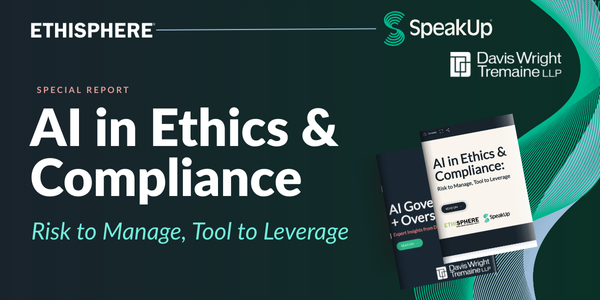
Over the course of 2025, E&C teams made huge advances in transitioning from a governance to implementation mindset around their use of AI. Ethisphere’s report on the topic captured the latest regulatory developments, case studies of real-world success stories, and more.
In other news:
- The New York Times reports that the Justice Department’s Inspector General is ignoring internal whistleblowing reports, creating ideal conditions for whistleblower intimidation within the department.
- The SEC drops a long-running, high-profile foreign bribery case against two former Cognizant employees, three months after the DOJ did the same. This pivot suggests the SEC will align with the Trump administration’s decision to not enforce the FCPA.
- AT&T CEO John Stankey stuns employees with a now-viral worded 2,500-word response to the company’s latest engagement survey in which he tells workers not to expect loyalty from their employer.
- EDGAR-adjacent insider trading case = vendor risk reminder. The SEC charged two Brooklynites who worked for an EDGAR filing services firm (not the SEC itself) with trading on material non-public information gleaned from upcoming client filings.
- DEI attacks are loud; shareholder support is louder. This proxy season, anti-DEI proposals averaged roughly 2% support across 32 marquee companies, with ~98% of shares effectively voting to maintain existing DEI programs.
- Why people blow the whistle (or don’t). New Q&A with sociologist Patrick Bergemann surfaces a few interesting dynamics. Among them: most external reports happen after internal reports go unanswered and cohesive teams are less likely to report on in-group misconduct but more likely to report outsiders. Keep an eye on this topic. It’s about to rear its head shortly…
SEPTEMBER
TOP STORY: Nestlé CEO Ousted Over Code Violation
On September 1, Nestlé, the world’s largest food company, dismissed CEO Laurent Freixe for his undisclosed romantic relationship with a direct subordinate. Freixe’s ouster is yet another CEO misconduct scandal in a year full of them.
Earlier in the year, Nestlé investigated allegations reported through the company’s Speak Up platform an inappropriate romantic relationship between Freixe and one of his direct reports, including allegations of favoritism. After the investigation proved inconclusive, Swiss financial news site Inside Paradeplatz publicly alleging that Friexe and his Vice President of Marketing were romantically linked. An external investigation confirmed the affair, and Nestlé’s board dismissed Freixe.
Paul Bulcke, Chairman, stated: “This was a necessary decision. Nestlé’s values and governance are strong foundations of our company. I thank Laurent for his years of service at Nestlé.”
In other news:
- A U.S. federal court orders Google to pay $425 million in class action lawsuit that claimed Google had accessed user data even when Web and App activity options were switched off. The original suit sought $31B in damages; what Google will pay amounts to the personal equivalent of a speeding ticket.
- Solar energy producer Azure Power agrees to pay $23M to settle a New York district court case over alleged bribery and other irregularities.
- The U.S. Securities and Exchange Commission (SEC) may disallow foreign companies to file financial statements using International Financial Reporting Standards (IFRS) accounting standards due to the IFRS Foundation’s formation and backing of the International Sustainability Standards Board (ISSB).
- McKinsey releases global GRC survey that observes a substantial correlation between seniority of risk/compliance personnel and the maturity of the E&C function.
- Harvard Business Review publishes article on how employees see middle managers as their organization’s moral compass
- AI developer Anthropic backs a California AI transparency bill that if passed, would set broad legal requirements for AI companies in the U.S.
- The Texas Office of the Attorney General investigates Glass Lewis & Co. and Institutional Shareholder Services for promoting ESG to investors
- A federal jury in Miami convicts a U.S. businessman for a bribery and money laundering scheme involving Honduran officials to secure the sale of law enforcement uniforms and accessories
OCTOBER
TOP STORY: Where Did the First Brands Money Go?
In early October, the DOJ launched an investigation into potential financial reporting irregularities surrounding the stunning bankruptcy of auto part retailer First Brands—whose products are sold through chains like AutoZone, Walmart, and independent shops. Its portfolio includes well known names such as Fram, Trico, Raybestos, Centric, Autolite, and Anco. The company stunned the financial world when it filed for bankruptcy in late September, disclosing $10-$50 billion in liabilities, and vast sums of money that may be unrecoverable.
The First Brands fiasco has raised broader questions about corporate debt loads, and prompted investor concern over the systemic risk posed by opaque private credit structures. Meanwhile, First Brands’ new leadership has since sued the company’s founder, alleging extensive fraud and misappropriations of perhaps billions of dollars.
In other news:
- Amazon will pay $2.5 billion to settle Federal Trade Commission allegations that the company tricked consumers into signing up for its Prime subscription service and then made it difficult to cancel.
- The Department of Justice indicts two companies and three executives for evading tariffs in a sale of Chinese forklifts to the U.S. Government. This, just a month after the DOJ formally announced it would partner with the Department of Homeland Security to crack down on tariff evasion.
- Harvard Business Impact writes that psychological safety is crucial for team success and is the “hidden engine” that powers innovation, transformation, and high performance.
- Tractor Supply Co. will pay $1.35 million to California for violating that state’s data privacy law, with implications for how companies handle the data of job applicants.
- Nature publishes a paper that demonstrates how delegating tasks to artificial intelligence (AI) facilitates can increase dishonest behavior.
- The EU Parliament reaches long-awaited compromise on sustainability reporting reductions
- “Ethical leadership is more than simply doing the right thing; it’s about doing the smart thing, as integrity is the ultimate competitive advantage,” Steve McNally writes in CFO around how ethical CFO leadership is a strategic differentiator.
- The South African Institution of Civil Engineering (SAICE) calls out the ongoing threat that corruption poses to the country’s infrastructure delivery, public trust, and professional integrity.
- The DOJ seizes $15B in Bitcoin —a record-setting forfeiture—from a massive Cambodian scam operation linked to human trafficking.
- Sequoia Capital faces ongoing backlash— including the resignation of its COO —for refusing to reprimand Shaun Maguire, one of its most successful traders, for public, Islamophobic comments made about New York mayoral candidate Zohran Mamdani.
- The Office of the Comptroller of the Currency drops its long-running case against a former Wells Fargo risk officer for failing to prevent that bank’s accounts scandal.
NOVEMBER
TOP STORY: CEO Arrested for Looting Own Company
On November 4, Brad Heppner, the former CEO and founder of investment firm Beneficent was arrested and charged for looting $150M from GWG Holdings, a firm that Heppner ran which sold life insurance-backed bonds to retail investors. According to prosecutors, Heppner looted GWG by way of a complicated series of transactions between GWG, Beneficient, and a shell company called Highland Consolidated Limited Partnership. Heppner abandoned GWG once it went bankrupt, costing thousands of investors more than $1 billion.
Heppner faces charges of securities fraud, wire fraud, conspiracy to commit securities fraud and wire fraud, making false statements to auditors and falsifying records in a federal investigation. If convicted, he could serve up to 20 years in prison.
In other news:
- Harvard Business Review writes that it’s good for companies to actively seek employee feedback, but first, they must build a culture of psychological safety to make feedback an accepted form of organizational currency. (Hint: Start by boosting psychological safety among your middle managers.)
- Fannie Mae fires at least 12 people in its ethics and internal investigations unit as well as its CCO Suzanne Libby and CEO Priscilla Almodovar.
- Georgia Institute of Technology has hired its first chief ethics and compliance officer by recruiting the chief compliance officer for the Research Foundation for the State University of New York.
DECEMBER
TOP STORY: SHRM Held Liable for Racial Discrimnination, Retaliation
On December 5, a Colorado jury found the Society for Human Resource Management (SHRM) liable for racial discrimination and retaliation. The jury awarded plaintiff Rehab Mohamed $1.5 million in compensatory damages, and $10 million in punitive damages. Mohamed alleged that her white supervisor racially discriminated against her, and that when she complained to management, she faced retaliation for it.
While SHRM will appeal the ruling, legal experts note that the case doesn’t look good for SHRM, which holds itself up as an arbiter of best practices.
In other news:
- ACCA Global releases a landmark report that reveals the interconnectedness and fragmentation that defines today’s AI-fuelled fraud landscape.
- Corporate landlord Greystar agrees to $24 million settlement with the FTC over deceptive rental fees, in which Greystar advertised low rents that failed to include additional monthly charges.
- FXStreet reports that big AI companies are listing unrealistic depreciation cycles for their own technology, in what could amount to a $176 billion fraud perpetrated upon shareholders. This, on the heels of commentary that the U.S. economy is now running on “magic beans.”
- Morrison Foerster earns its fourth consecutive Gold Rating in the PRIDE Index 2025, which gauges LGBTQ+ inclusivity across corporate Japan.
- Fortune reports that after Elon Musk’s Boring Co. was cited for safety violations, the Nevada governor’s office stepped and made it all go away…including evidence of the meeting itself.
- The Government Accountability Office has opened an investigation of Federal Housing Finance Authority Director Bill Pulte, who raised alarm bells earlier this year when he fired ethics workers who were looking into his political ally.
Further Reading
For the stories about major ethics and compliance issues that made headlines in 2024, check out our related story, A List of Major Ethics and Compliance Issues. For helpful context and insights on important ethics and compliance news stories as they develop, subscribe to the Ethicast podcast. For a host of free resources on the many topics covered in these news stories, visit the Ethisphere Resource Center.
Prove Your
Ethics Program Works.
Benchmark your ethics & compliance program against Fortune 500 leaders.
- Prove your program’s effectiveness
- Prioritized roadmap for improvement
- Implement Proven Tools & Processes
Author Bio
Bill Coffin | Editor-in-Chief, Ethisphere Magazine, Ethisphere
Bill Coffin is an internationally recognized writer and editorial leader in the fields of ethics, compliance, insurance and risk management. His work has appeared in The Wall Street Journal, BusinessWeek, Forbes and Fortune, as well as Compliance Week, National Underwriter, Risk Management, Best’s Review and other B2B media. Previously, Bill served as Director, Senior Editor at AIG, leading content strategy for one of the world’s largest insurance companies.