5 Minutes - Read Now

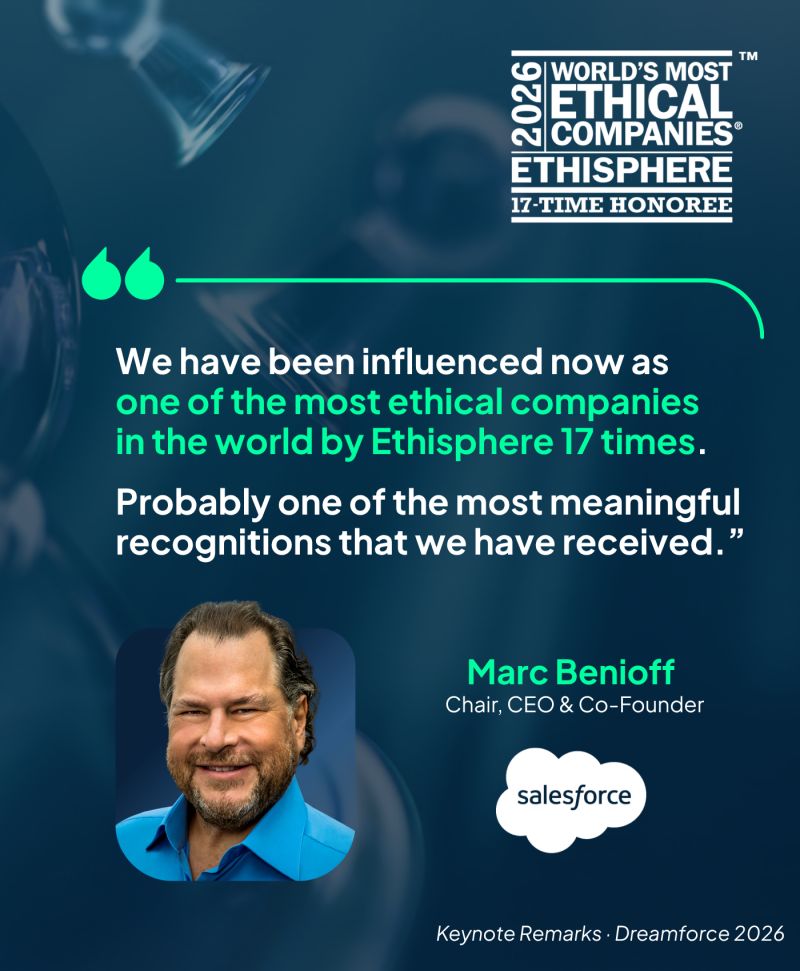
This week, at Salesforce’s Dreamforce, Marc Benioff’s keynote discussed the pillars he says built the company: trust, innovation, equality, sustainability. Then he added one more, being named one of the World’s Most Ethical Companies® 17 times, which he called “probably one of the most meaningful recognitions that we have received.” He talked about their World’s Most Ethical Companies designation immediately after discussing Salesforce’s core values and immediately before discussing the company’s financial growth.
That placement isn’t a coincidence. In a keynote of this importance, organizations craft every word with intention, carefully honed, and close review. The World’s Most Ethical Companies made the final cut.
While putting ethics and financial performance in the same breath makes for good stagecraft, Ethisphere’s own longitudinal analysis, the Ethics Premium™, found that this year’s publicly traded Honorees outperformed a broad global stock benchmark by 8.2 percentage points from Jan. 1, 2021 through Dec. 31, 2025. When Benioff paired ethics with revenue growth, he did so because there is a real data connection between the two.
It’s not unusual for a company’s leadership team to put their belief in ethics alongside their core values and their financial performance. It may not always be on a livestream at the largest SaaS conference on Earth, but we increasingly see companies disclose their recognition and commitment to E&C through avenues that require scrutiny, legal and communications sign-off and carry real regulatory weight.
The data: disclosure is the key signal
90% of this year’s 138 Honorees referenced their recognition somewhere that requires legal or disclosure review: SEC filings, annual reports, formal press releases, or corporate identity pages. That count excludes social media, which is cheap to publish and carries no review cycle. These are companies choosing to attach their name to a designation when doing so comes with reputational and regulatory cost, not when it’s free.
That disclosure comes with internal costs too. Referencing an outside recognition in a 10-K or a proxy statement typically means legal review, comms sign-off, and often a conversation with investor relations. Companies don’t route something through that much friction because it’s decorative.
For example, in General Motors’s 2026 proxy statement, Audit Committee chair Alfred F. Kelly Jr. cites the recognition as evidence of board-level compliance oversight, not brand messaging: “This is evident through Ethisphere recognizing GM for the seventh consecutive year as one of the World’s Most Ethical Companies, and our recent modernization and comprehensive refresh to the Company’s Code of Conduct.” That’s a director using the designation as a governance proof point, in the same document that discloses executive pay and board composition.
The J.M. Smucker Company’s most recent 10-K does something similar. Under Item 1’s Human Capital Management discussion, alongside its Code of Conduct, Integrity Portal, and Ethics and Compliance Survey, the filing states: “We are pleased to share that our Company was recognized in 2026 as one of the World’s Most Ethical Companies by Ethisphere, a global leader in business ethics, for a third consecutive year.” Mentioned as it is in the 10-K, this becomes a load-bearing detail. More importantly, it acts as evidence supporting the company’s own stated commitment to doing business the right way, in the one document companies are least willing to pad with fluff.
And we’re seeing clear accelerations in these reputational and regulatory mentions. Filings referencing the recognition specifically rose 43% from 2017 to 2022, then 67% from 2022 to year-to-date 2026. Over the full decade, that’s a 138% increase, with more than three months still left to file in 2026.
A story that’s combining
Companies are no longer treating ethical culture and financial performance as separate storylines that happen to both be true. They’re narrating them together, in the same sentence, by the same executives, in the same disclosure documents. And now, there’s a five-year performance record behind it. Benioff’s keynote line, the Ethics Premium’s 8.2-point outperformance, and the SEC filing data are the same phenomenon measured at rhetorical, financial, and structural levels. None of them means much without the others.
Where this goes next
As ethics recognition increasingly clears legal and comms review to enter the disclosure record, expect it to keep migrating from a nice mention to an expected line item in how leading companies describe their performance to the market. This migration has been 20 years in the making and what Ethisphere is dedicated to every day. The ongoing work of proving that strong ethics is good business with evidence, not good intentions. Benioff’s keynote didn’t invent the association between values, integrity, and company performance. But he did make an intentional choice to make the link between all three explicit. And while we’re very excited about all the innovations that Salesforce is launching, Benioff’s keynote speech shows how far the case for business integrity has traveled.
Author Bio

Julia Petre | Head of Marketing, Ethisphere
Julia Petre is Head of Marketing at Ethisphere, where she leads the company’s marketing strategy across growth, demand generation, product marketing, brand, thought leadership, events, and analytics. She is responsible for turning Ethisphere’s story into measurable growth by shaping the company’s narrative, generating pipeline, and equipping teams to clearly communicate how Ethisphere’s products and services help ethics and compliance leaders succeed.