9 Minutes - Read Now
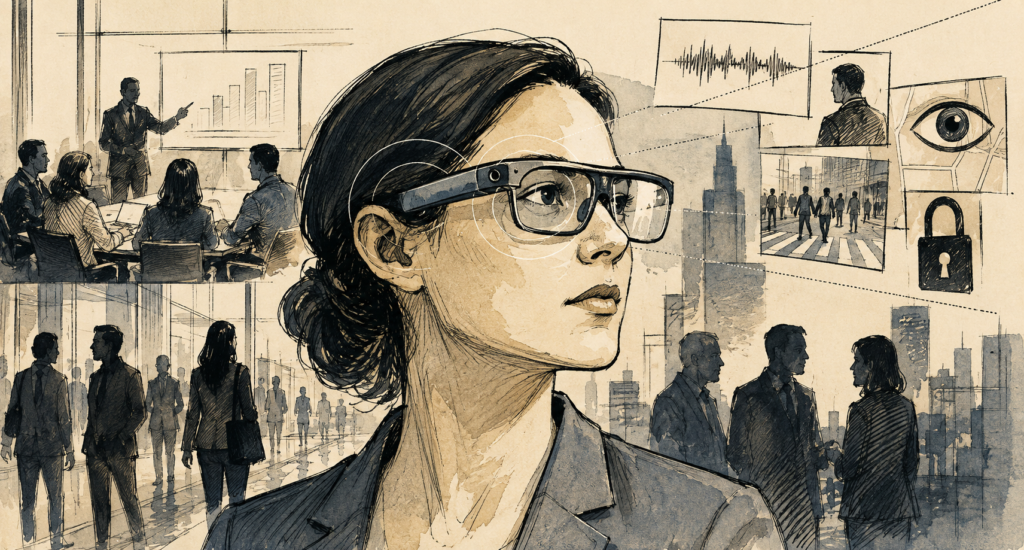
After languishing for years as a high-tech novelty without mass-market appeal, smart glasses—everyday eyewear equipped with built-in cameras, microphones and other digital or data features—took off in 2024 and 2025 with the advent of sleek, lightweight models like the Ray-Ban Meta and Oakley Meta Vanguard lines. As a technology class, smart glasses has become a widespread piece of everyday technology that incorporates Bluetooth, wireless internet connectivity ,as well as AI functionality. That mix of features, which can be used covertly and without the consent of others, now poses considerable data privacy and security concerns, as well as widespread social angst.
Case in point: so far in 2026, the U.S. Air Force barred recording-capable glasses for personnel in uniform. New York State courts banned them from all 1,240 courthouses. The DefCon security conference prohibited them with no exceptions. Royal Caribbean restricted their use across its ships. UK Comic Con promoter Monopoly Events banned them after event guests and attendees complained of being recorded secretly.
Meta’s glasses are driving the questions E&C teams are getting about this innovation, and reasonably so, since Meta owns the market. But building a policy around one product is how you end up rewriting it in eighteen months. Case in point: when Google launched the Explorer program in 2013 to promote its new Google Glass smart glasses, backlash over privacy concerns led Nevada’s Gaming Control Board to encourage casinos to prohibit the product on gaming floors — guidance that operators like Caesars and MGM Resorts adopted. But by January 2015, Google discontinued the Glass Explorer program entirely, rendering moot a policy built around a specific product rather than the underlying risk it posed: face-worn cameras that can record people without their knowledge or consent.
Maybe you just finished updating your policies to note where recordings of meetings are supposed to be stored. (If not, go do that. Records retention, never the most scintillating topic, is critically important now.) Thanks to the spread of recording-capable glasses, those policies should be updated. Here are some things to consider as you do.
The Consent Signal Is Getting Dimmer
Consent has been the thing everyone has relied on to govern this area thus far, but the entire consent model for camera glasses rests on one small LED that tells bystanders the camera is live. Reporting in July, based on leaked internal documents, suggests Meta has weighed leaving that light off during an always-on “super sensing” mode, on the theory that continuous AI perception isn’t recording.
Whether always-on AI perception becomes a feature of smart glasses, the mere discussion of it raises a tricky legal question. If a device processes everything it sees and hears without producing a file, has it really recorded anyone? Most corporate policies can’t really answer that, since they were written when recording meant a discrete act with a start and a stop.
The second point is less obvious and matters more in practice. Audio and video sit in different legal universes. Wiretap and eavesdropping statutes generally reach oral communications, not silent video. The same pair of glasses is an etiquette problem in one mode and potentially a crime in another (especially in all-party-consent states, such as California, Florida, and Pennsylvania.) How aware are your employees of these legal distinctions?
Pick up the risk assessment you did when your employees turned on the AI-notetaking functionality in meeting platforms like Zoom or Teams. How did you talk to employees about how to ask peers not to transcribe or record a meeting? How many people actually used the ability to say no? The presence of wearables in your workforce makes the conversation around handling requests not to record more important. Make sure your managers know how to navigate this issue and have the channels to raise questions they don’t have the answers to, especially if you think your employees would be anxious to ask someone not to record.
The Data Goes Somewhere You Don’t Control
Per Meta’s own privacy notice, Meta stores voice recordings and transcripts in the cloud by default and retain them for up to a year. Meta removed the opt-out from AI training in 2025. Recordings are reviewed by human annotators, including third-party contractors, and reporting in March described sensitive recordings routed to workers for annotation.
Read that back as a vendor risk assessment. Your confidential information, sitting on a third party’s infrastructure, under consumer terms your legal team never saw, reviewed by people you haven’t vetted, on a retention clock you don’t set, training a model.
Then think about discovery. If an employee’s glasses captured something relevant to a matter, does your litigation hold reach a personal Meta account? Can you collect it? Can you show a court you made a real attempt?
The precedent to keep in mind is off-channel communications. To date, financial firms have paid billions in penalties because employees did business on ephemeral messaging platforms like WhatsApp and the firms couldn’t produce the records. Sometimes, the issue isn’t deliberate destruction of evidence, but the creation of evidence that lies outside the company’s control and self-destructs. Whether that’s done intentionally or not, wearables present that same fact pattern, this time with a camera attached.
Biometrics Is Where the Statutory Damages Live
Cameras and always-on transcription generate face data, voiceprints, and gaze data. Illinois’s Biometric Information Privacy Act (BIPA) carries a private right of action with per-violation statutory damages. The GDPR treats biometric data as special category, requiring explicit consent.
If your company issues glasses for a legitimate reason (field service, warehouse training, remote inspection, etc.), and those glasses transcribe meetings, you may be collecting voiceprints from everyone in the room without notice or written consent. In this context, the (potentially unintended) consequence of your sanctioned deployment is your main exposure, not a rogue employee.
If you operate in Europe, note that the European Data Protection Board commissioned a study on the social acceptability of smart glasses, due to wrap this summer, which is usually the prelude to coordinated guidance. Works council consultation obligations attach if you’re the one issuing the devices. And pay attention to the EU AI Act’s language on this issue as well.
Banning Them Is Harder Than It Sounds
Most companies’ first instinct is prohibition. Aside from the enforceability of such action, consider two other problems it raises.
The first is NLRA Section 7. The Board scrutinizes handbook rules that could chill protected concerted activity, and employees recording unsafe conditions, harassment, or conversations about wages may be protected. A flat no-recording rule needs a documented business justification and explicit savings language.
The second is the ADA. Smart glasses are genuine assistive technology for people with vision and hearing impairments. Refusing them categorically, without running the individualized interactive process, is a disability discrimination claim waiting to be filed.
HR will be your partner here. Work with them to write for device categories rather than brand names. Build a case-by-case exception path into the policy from the start.
Your Approach Doesn’t Cover Most of the People Wearing Them
Visitors, customers, patients, contractors, auditors, delivery drivers, and job candidates all walk through your doors. An employee policy binds none of them. Covering that population takes different instruments, including premises rules and signage, visitor terms at badge-in, confidentiality clauses in vendor and supplier contracts, and specific restrictions for spaces where a recording would be unrecoverable. To the extent your employees are wearing them to client sites, make sure they understand the restrictions your organization might have agreed to as well.
It’s also worth admitting the enforcement problem in writing. You can’t spot these at reception. They look like eyewear. The control is mostly cultural. It’s embedded in the way your stakeholders use this technology and whether they understand the risks, which is exactly why this belongs to ethics and compliance rather than physical security.
Consider the Culture Angle
When employees start wearing recording devices into meetings, what does that tell you about whether they trust your reporting channels?
Ethisphere’s culture data, drawn from more than four million employee responses, shows 94 percent of employees saying they would report misconduct if they observed it. Among those who actually observed something in the previous twelve months, roughly half reported it. The two most common reasons for staying quiet were a belief that nothing would be done, cited by 49 percent, and fear of retaliation, cited by 48 percent.
An employee who quietly records a meeting has usually made a calculation. They think they’ll need proof, and they don’t think the process will protect them. Treat that as a policy violation and you’ve addressed the symptom, not the cause. Feeling the need to record is a culture signal, and unlike many culture signals, it’s measurable. Add a question about it to your next assessment.
The reverse deserves attention too. A manager wearing always-on glasses into a performance review, a 1:1, or an investigation interview is doing something categorically different from a peer wearing them in a team meeting. Power asymmetry changes the act. Most recording policies treat every wearer the same way, and they shouldn’t.
Seven Things to Do in the Next Quarter
- 1. Inventory the rooms where a recording would be catastrophic, and post signage there. Board rooms, deal rooms, HR suites, clinical space, labs, patient spaces, anywhere export-controlled technical data is visible.
- 2. Rewrite the recording policy to cover device categories, with NLRA savings language and an ADA exception path. Add a “is this an appropriate place to wear these?” decision tree in to guide employees as the technology changes.
- 3. Build this into your training and communications plan
- 4. Add wearables to visitor terms and to vendor and contractor agreements. Don’t over-index on specific brands or products; focus on the technology category.
- 5. Ask Legal whether your hold notices reach personal wearable data, and what you would say if a regulator asked you to produce it.
- 6. Decide now how investigations will handle footage that arrives as evidence: authentication, chain of custody, retention, and the non-parties captured in frame.
- 7. Name an owner. This sits between privacy, security, HR, and legal, which usually means nobody has it. This will be a cross-functional risk, but someone needs to lead the team.
The smart glasses dominating today’s headlines may not even be on the market in a year’s time. But the questions they raise—and the underlying technologies they employ—will not go away. Determine your answers to those questions now, crisis-free and on your own schedule, rather than after an incident that forces you to.
Author Bio

Erica Salmon Byrne, J.D. | Chief Strategy Officer and Executive Chair, Ethisphere
As Chief Strategy Officer and Executive Chair, Erica Salmon Byrne is responsible for ensuring continuous and strong growth for the company while maintaining Ethisphere’s founding ethos that good businesses do better.