5 Minutes - Read Now

It’s remarkably easy to identify moments where organizations did not make the ethical choice and paid a steep price. Lost market share, falling stock prices, tarnished reputations, regulatory scrutiny, fines, and even criminal judgments—these are the consequences organizations risk when ethics are sidelined.
Often, such crises aren’t the result of a single misstep, but rather stem from lingering, systemic deficiencies in corporate culture, especially where integrity isn’t prioritized. When organizations don’t emphasize ethics, they can foster environments where questionable or harmful behavior not only emerges but flourishes.
Organizations may not be giving this area the concentrated attention it deserves, particularly from the top down. In a 2024 survey from the Society for Corporate Governance and Deloitte, 48% of respondents reported that their boards of directors provide no dedicated oversight of corporate culture.[1] Of those that do watch culture, many monitor whistleblower complaints or hotline reports, meaning they might step in after an ethics issue has already emerged.
Both the stakes and challenges of an ethical corporate culture are high. Today’s workforce brings new values that can challenge traditional business norms. Global complexity, technological disruption, and instantaneous media can elevate the speed and impact of any ethical lapse. As a result, organizations should consider rethinking how they approach ethical leadership, shifting from reactive crisis management to proactive risk sensing and rapid response.
What is ethical leadership?
Ethical leadership means pairing a tone at the top with practices that embed ethical values and conduct throughout an organization. Ethical leadership tracks closely with trust: When leaders are visible and consistent in their commitment to ethics, trust can flourish among stakeholders. When ethical leadership is absent, organizations risk a dramatic loss of trust.
That trust delivers real, measurable value. A Deloitte Canada Human Experience TrustIDTM Survey found that companies recognized for trustworthiness outperform peers by a factor of four in market value, and 88% of customers will return to buy from a brand they trust.[1] In the Deloitte Global report “How boards are nurturing and measuring stakeholder trust,” 81% of board members and C-suite leaders stated that trust directly affects their business relationships.[2]
In high-pressure moments, ethical decision-making can get hazy. Every day, employees make countless choices—responding to sales goals, addressing customer issues, satisfying investors. Whether those responses are ethical depends on how deeply integrity is threaded into the organization’s culture and modeled by its leaders.
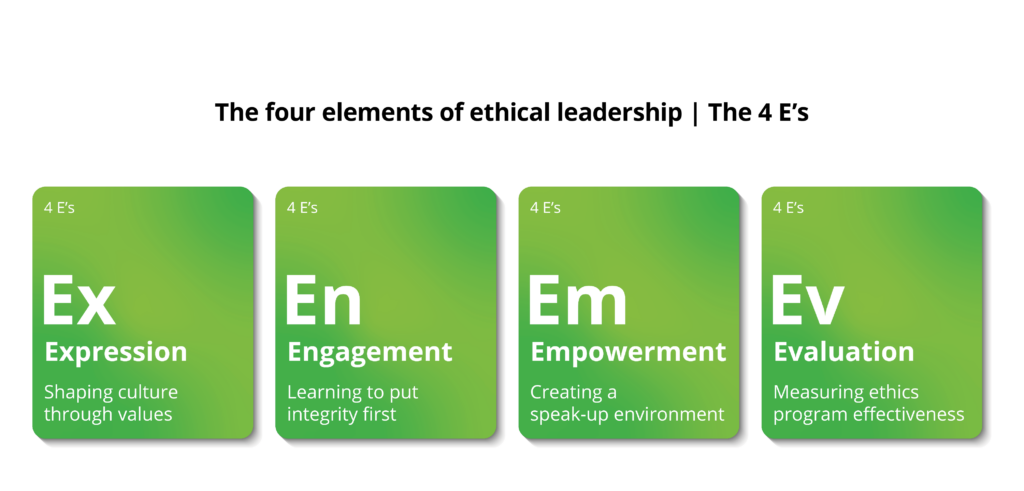
Effective ethical leadership helps ensure the ethical choice is the reflexive choice. The four elements of ethical leadership, or the 4 E’s, provide an actionable leadership approach for building ethical cultures:
Expression: Shaping culture through values
Organizations should communicate their ethical standards clearly and frequently, expressing both their values and expectations. Messaging should also express how the organization will respond when its expectations are violated. Consistent messaging—through meetings, communications, and presentations—fosters an environment where ethical behavior is standard and unethical behavior is discouraged.
Engagement: Learning to put integrity first
Continuous learning and training can give employees the tools to make decisions rooted in integrity. Understanding the ethical implications of their actions helps workers navigate dilemmas and comply with laws. Learning should happen regularly at all levels, starting with new hires. Scenario-based refreshers should cover realistic ethical dilemmas, bringing timely and relevant scenarios to life while also highlighting new and emerging ethical risks.
Empowerment: Creating a speak-up environment
To surface ethical concerns early, organizations should provide safe channels for employees to report or consult on issues. Multiple options—including conversations with supervisors and anonymous reporting lines—make speaking up accessible and comfortable, which can help prevent nascent risks from becoming full crises. Centralizing ethical values helps give employees confidence to raise concerns without fear.
Evaluation: Measuring ethics program effectiveness
Given rapidly changing risks, organizations should consider formalizing ethical leadership metrics. Stakeholder interviews, focus groups, and benchmarking help leaders monitor trends and update programs. Celebrating ethics champions and weaving ethical leadership into performance goals reinforces the value placed on integrity.
Summary
No organization is immune to ethical challenges that can impact its brand and reputation. But when an organization develops specific strategies to continuously elevate its ethical leadership, it can mitigate that risk. Strong ethical leadership can help an organization head off ethical concerns before they happen and respond swiftly and effectively—and yes, ethically—when they do.
Sources
- Natalie Cooper, Bob Lamm, and Randi Val Morrison, “Board oversight of culture,” Board Practices Quarterly, Deloitte and Society for Corporate Governance, July 2024, p. 6.
- Deloitte Canada, “The future of trust: A new measure for enterprise performance,” 2021, p. 2; Deloitte Human Experience TrustID Survey, May 2020 (n = 7,500).
- Jo Iwasaki, “How boards are nurturing and measuring stakeholder trust,” Deloitte Insights Magazine 31, February 2, 2023.
This article was originally published on Deloitte.com. Read the full report, and watch Deloitte.com for additional content exploring the 4 E’s and other ethics topics. Copyright © 2025 Deloitte Development LLC. All rights reserved.
Author Bio

Lori Pressler | Chief Ethics Officer, Deloitte LLP, Guest Contributor
Lori is an audit Partner at Deloitte with over 25 years of experience serving domestic and global clients. She serves as the Chief Ethics Officer for the Deloitte US firms and as a National Professional Practice Director for the Audit & Assurance Practice.

Michael Rossen | Managing Director, US Ethics Office, Deloitte, Guest Contributor
Michael is a managing director in Deloitte’s US Ethics Office. He is focused on implementing and overseeing programmatic approaches to elevate the organization’s ethics culture, supporting Deloitte’s unwavering commitment to integrity, trust, and quality. He has 25 years of Deloitte experience advising clients on complex matters encompassing ethics, integrity, compliance, organizational culture, risk, forensic investigations, crisis management, and corporate governance.

Miira Velia | Managing Director, US Ethics Office, Deloitte LLP, Guest Contributor
With over 25 years of experience in ethics, compliance, and regulatory affairs, Miira serves as a managing director in Deloitte’s US Ethics Office. With a mission to foster an ethical culture throughout the organization, she develops and manages strategic initiatives designed to support Deloitte’s commitment to integrity. Miira also oversees critical Ethics Office operations, including ethics policy management and investigations and case management, and she provides strategic guidance on ethical risk management.