6 Minutes - Read Now
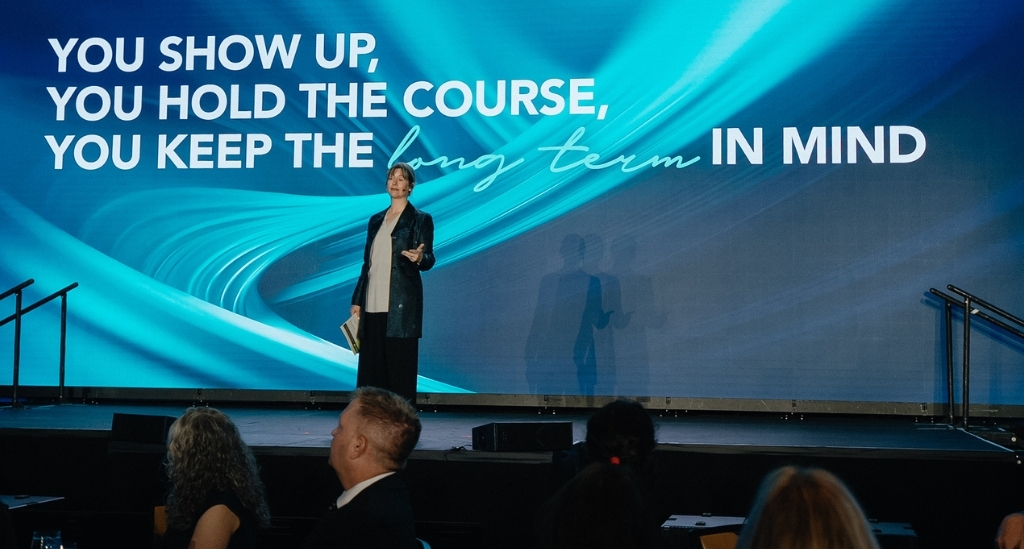
I had a chance to share some thoughts at our celebration of the 2026 World’s Most Ethical Companies® a couple of weeks ago, and it caused me to reflect on the last 20 years.
Take a minute to think back. Where were you in 2006? What were you doing 20 years ago?
I was undoubtedly manically thumb-typing on my BlackBerry, listening to Beyoncé. Someone in my life was probably excited about a soccer match; I was almost certainly mourning the series end of The West Wing. Maybe I was heading to meet my sisters to see The Devil Wears Prada in the movie theater, where we’d debate as we left whether Twitter would make it as a platform and why Pluto was a planet and the revised designation was wrong.
And at work, we were pulling together the first-ever edition of a little thing called the World’s Most Ethical Companies. It was an audacious and forward-looking concept, focused on celebrating companies that were prioritizing business integrity, that we’ve now been doing for 20 years.
20 years. That’s incredible.
Reflect for a moment on the change we have seen over the last 20 years. While soccer, Beyonce and The Devil Wears Prada are still with us, the launch of the iPhone meant goodbye to my treasured BlackBerry. Consider the rise of social media platforms and the impact on our attention spans. The Great Recession. The launch of Bitcoin. Natural disasters, #MeToo, geopolitical changes: it goes on and on, and it feels like it is accelerating constantly. We all wake up every day and take a deep breath before we check the news because there has been so. Much. Change.
But, to quote French novelist Alphonse Karr, plus ca change, plus c’est la meme chose. Or as we often say in English, “The more things change, the more things stay the same.”
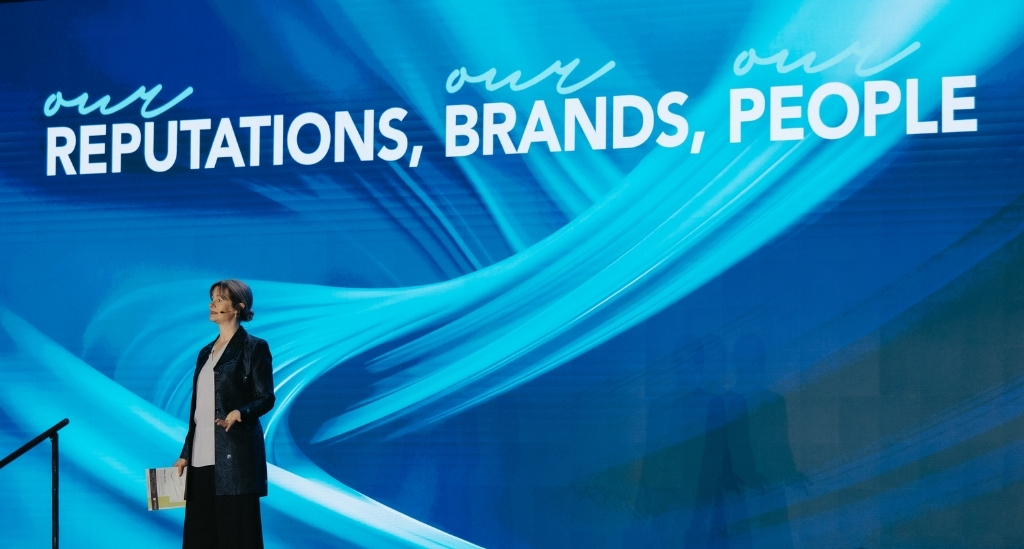
We’re all still here. Doing this work together. Every day, in the little moments, putting the tools in the hands of organizations to make sure that employees are making the right choices, asking the right questions, and raising the right concerns. All to safeguard the intangible assets that comprise an average of 80 percent (and maybe as much as 90) of the value of organizations today: our brands, reputations and people.
The Long-Term Value of Ethics
And it is hard. Part of that Karr phrase—when said with world-weary emphasis—resonates with me. It can feel like no matter what, nothing changes. It can encapsulate a resignation that we have all felt, when it would be so much easier to just say “fine, go ahead.” Go ahead to the sales rep who wants to cut corners on onboarding a client. Go ahead to the senior executive who doesn’t want to disclose the romantic relationship with that vendor. Whatever to that business partner who thinks in the interest of speed that diligence isn’t needed “just this once.” How many times have we all heard “just this once?”
But you don’t. You show up, you hold the course, and you keep the long term in mind. And our data shows that you benefit so many with that commitment: your investors, your stakeholders, your third parties, your employees.
That constancy, that consistency…that is reflected in our World’s Most Ethical Companies process. And it is particularly reflected in the Ethics Premium™, which to us is the business case for why the commitment to integrity matters so much.
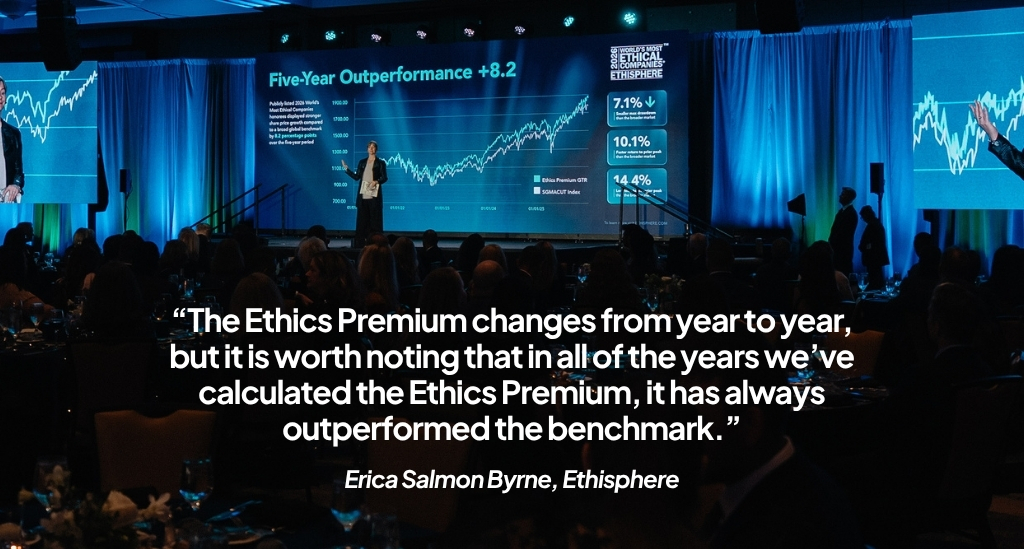
The Ethics Premium measures the five-year financial performance of the publicly listed members of the World’s Most Ethical Companies (approximately 85 percent of the 2026 list). The 2026 Ethics Premium is +8.2 percentage points, which means that the grouping of 2026 WMEC honorees over the last five years outperformed a broad global benchmark of similar, large-cap companies.
The Ethics Premium changes from year to year, but it is worth noting that in all of the years we’ve calculated the Ethics Premium, it has always outperformed the benchmark. This, of course, is correlation not causation: but it is a decade of remarkably strong correlation showing that companies with a commitment to integrity outperform. Every year, the World’s Most Ethical Companies cohort changes. Every year, the world’s macroeconomic conditions change. And yet every single year, the Ethics Premium remains positive in favor of highly ethical organizations. This is a critical distinction for proving something that Ethisphere believes firmly: strong ethics is good business.
The Resilience of Integrity
This year, the Ethics Premium was further expanded to reflect the greater stability and resilience of highly ethical organizations when it comes to preserving their value against the inevitable market downturns that occur over the course of a full market cycle. What this expanded data set shows is that over the last five years, the World’s Most Ethical Companies, when faced with broad market downturns, lost less of their value than benchmark. Their stock prices stayed underwater for a shorter amount of time than benchmark. And their stock prices regained their value faster than benchmark.
So while the +8.2 percentage point delta shows that highly ethical companies profit more than their peers, the expanded Ethics Premium shows that they also do better at protecting the value they have built. This does not reflect a single lucky year or a single lucky stretch. This shows a broad resiliency even against periods of acute turmoil, which we saw in September 2022 when the market took a sharp dip downward. Even during that time, the World’s Most Ethical Companies lost less value than benchmark.
The Ethics Premium shows with publicly available data that highly ethical organizations are made stronger by their long-term commitment to business integrity. And by extension, that a long-term investment in a robust ethics and compliance program is not a sunk operating cost, but rather, a positive investment in future financial growth.
The financial performance of the World’s Most Ethical Companies is not what earns their recognition from Ethisphere. Rather the World’s Most Ethical Companies recognition acknowledges the highly ethical business practices that build value, foster innovation, gain and retain talent, and reduce risk. All of these practices reflect their value-creation power in the Ethics Premium.
It is easy in times of turmoil to sail with the prevailing winds. But the resilience of integrity is deep enough that we don’t have to. We can make a different choice—in moments big and small—and I look forward to celebrating those choices next year and in the decades to come.
Putting a different spin on it—plus ca change, plus c’est la meme chose—and thank goodness for it.
Author Bio

Erica Salmon Byrne, J.D. | Chief Strategy Officer and Executive Chair, Ethisphere
As Chief Strategy Officer and Executive Chair, Erica Salmon Byrne is responsible for ensuring continuous and strong growth for the company while maintaining Ethisphere’s founding ethos that good businesses do better.