BELA Asks: What Are Appropriate Consequences for Failing to Complete Training?

Ethicast

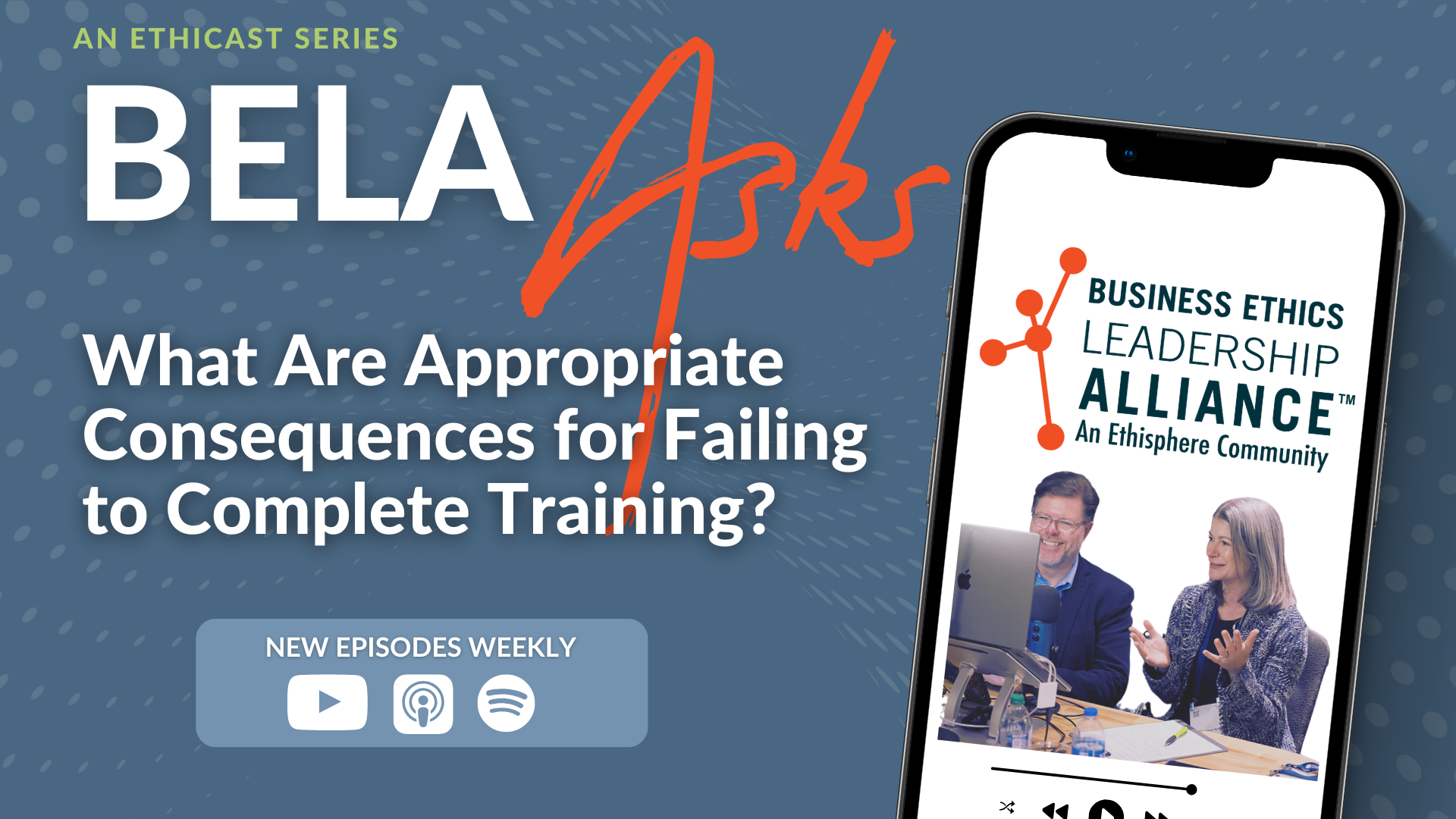
BELA Asks: What Are Appropriate Consequences for Failing to Complete Training?

BELA Asks: What Are Appropriate Consequences for Failing to Complete Training?

In our BELA Asks series, we address questions posed by members of the Business Ethics Leadership Alliance (BELA) about wider issues facing the ethics and compliance community. BELA members who have any questions at all about ethics and compliance can send them to us, and then our internal experts will provide an answer and/or direct them to a helpful resource for more information.

In this BELA Asks episode, BELA Chair Erica Salmon Byrne answers the question: What are appropriate consequences for failing to complete training?

To learn more about BELA, please visit https://bela.ethisphere.com to request guest access to the BELA Member Resource Hub and to speak with a BELA Engagement Director.

If you have a question that you’d like answered on BELA Asks, be sure to use the BELA Concierge Service, and we will get to it as soon as we can.
Preparing for the Shift: Chevron Deference & Its Effect on Ethics and Compliance Strategies

on-demand webcasts

Preparing for the Shift: Chevron Deference & Its Effect on Ethics and Compliance Strategies

Preparing for the Shift: Chevron Deference & Its Effect on Ethics and Compliance Strategies

As we approach year-end planning, join us for an insightful webinar on the implications of the recent shift in Chevron deference. This pivotal change could reshape how ethics and compliance teams operate and interact with regulatory frameworks. We explore what this means for your organization, strategies for adapting to new legal landscapes, and best practices for ensuring robust compliance in a post-Chevron world.

Ethicast: 4 Culture Assessment Insights

Ethicast

Ethicast: 4 Culture Assessment Insights

Ethicast: 4 Culture Assessment Insights

In this episode, we hear from Ethisphere culture experts Emilie Anderson, Katie Kruger, Doug Allen, and Curtis Leicht on some of the most important considerations around culture assessments, including what culture assessment really measure, how to apply demographic filters to culture data, how long culture assessments ought to take, and the importance of training managers to boost your culture findings.

BELA Asks: What Are Good Data Sources for Measuring Program Effectiveness?

Ethicast

BELA Asks: What Are Good Data Sources for Measuring Program Effectiveness?

BELA Asks: What Are Good Data Sources for Measuring Program Effectiveness?

In our BELA Asks series, we address questions posed by members of the Business Ethics Leadership Alliance (BELA) about wider issues facing the ethics and compliance community. BELA members who have any questions at all about ethics and compliance can send them to us, and then our internal experts will provide an answer and/or direct them to a helpful resource for more information.

In this BELA Asks episode, BELA Chair Erica Salmon Byrne answers the question: What are good data sources for measuring program effectiveness?

To learn more about BELA, please visit https://bela.ethisphere.com to request guest access to the BELA Member Resource Hub and to speak with a BELA Engagement Director.

If you have a question that you’d like answered on BELA Asks, be sure to use the BELA Concierge Service, and we will get to it as soon as we can.
Ethicast: Coffin’s Corollary: Ethics Scales Infinitely Upward

Ethicast

Ethicast: Coffin’s Corollary: Ethics Scales Infinitely Upward

Ethicast: Coffin’s Corollary: Ethics Scales Infinitely Upward

It has been a busy time for ethics and integrity news in recent months: executives going to jail, companies receiving massive fines and penalties, CEOs being dismissed or stepping down, and class action lawsuits. But perhaps the unlikeliest ethics scandal is the cheating allegation that rocked the 2024 World Conkers Championship.

In his editorial from the upcoming Fall issue of Ethisphere Magazine, Editor-In-Chief Bill Coffin explains how even in a world as small and insular as that of competitive conkers (what is conkers, anyway?), conflicts of interest and speak-up culture matter just as much as they do at any Fortune 500 organization. Why? Because no matter the stakes, ethics is everything.

Turning ECCP Guidance into Practice

Evaluation of Corporate Compliance Programs

Turning ECCP Guidance into Practice

Turning ECCP Guidance into Practice

In September 2024, the Department of Justice released updated guidance on their Evaluation of Corporate Compliance Programs (ECCP). In this guide:

  • Learn how the updates impact your ethics and compliance program
  • Gain data insights into how your Fortune 500  peers are addressing key areas of focus
  • Download resources to inform immediate improvements