
8 Ways to Elevate Ethical Culture: Measuring the Perceptions of Peers and Environment

8 Ways to Elevate Ethical Culture: Measuring the Perceptions of Peers and Environment

AUTHOR:
Erica Salmon Byrne, J.D.
President

In this series, we share insights into the eight pillars that make up a robust ethical culture. Our eight pillars seek to get at the key metrics of a strong ethical culture: do your employees understand what is expected of them, do they know where to go if they have questions, and if they need help or have made a mistake, do they trust the process enough to ask for it?

Today’s post focuses on perceptions of peers and environment.
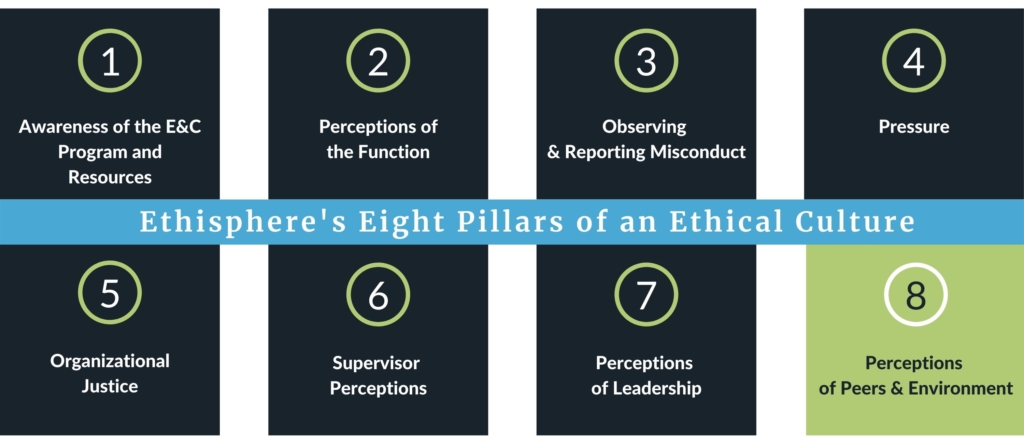
Pillar Eight: Perceptions of Peers and Environment

What we aim to measure:

Employee perceptions of their peers and the environment in which they’re doing their day-to-day work.  

Types of questions we ask:

  • I believe my co-workers act ethically.I believe senior leadership acts ethically.
  • I feel a personal responsibility to act ethically.

Why it matters:

The environment in which we work – much like the manager we work for (see Pillar 6) – influences our behavior on a daily basis. Accepted behavior being modeled by co-workers, and not commented on by management, will undermine a formal values system quickly. Those interested in this topic of informal values should see the work of Francesca Gino and Max Bazerman, and then use data from this pillar to identify places where informal systems might be working against the formal ones.  

What the data says:

This pillar tends to be an area of strong performance for most companies, with less favorable responses tending to coalesce in “neutral” or “neither agree nor disagree” concentrations as opposed to actively negative perceptions.

83 percent of surveyed participants believe that their co-workers act ethically at all times, with 13 percent responding neutrally

91 percent of survey participants feel personally responsible for making sure the company behaves ethically

As noted, the bulk of non-favorable responses in this category tend to be neutral. What we generally find when we dig into that data is most employees say they don’t know enough of how their co-workers are acting to respond affirmatively. This is a trend we have seen exacerbated by the pandemic, with an increasing share of employees working remotely and therefore intentionally distanced from co-workers.

How Ethisphere clients have used the data/insights:

Organizations typically use the data from this pillar to identify those locations where that challenge of distance seems largest, and then review with local leaders the extent to which they are engaging in storytelling when sharing goals with employees. Do they explicitly talk about ethical decisions they have made or how they might handle a given situation? Do they challenge behavior appropriately? Do employees see that behavior that is not in line with the stated values of the organization is addressed?

Expert tips for your program:

  • Use demographics to identify where your greatest opportunities lie. Is it by region, by brand, or by location? Perhaps by tenure?
  • Talk to local leaders about how to discuss decision-making with their teams. Shared experiences and learning at the local level allow for more informed decision-making.
  • Peer to peer exchanges carry an enhanced level of validity, and thus are more likely to positively influence behavior.

Have questions about ethical culture? Schedule time to talk with an Ethisphere expert.

8 Ways to Elevate Ethical Culture: Measuring the Perceptions of Leadership

8 Ways to Elevate Ethical Culture: Measuring the Perceptions of Leadership

AUTHOR:
Scott Stevenson, M.B.A.
Director, Culture Services

In this series, we share insights into the eight pillars that make up a robust ethical culture. Our eight pillars seek to get at the key metrics of a strong ethical culture: do your employees understand what is expected of them, do they know where to go if they have questions, and if they need help or have made a mistake, do they trust the process enough to ask for it?

Today’s post focuses on perceptions of leaders.

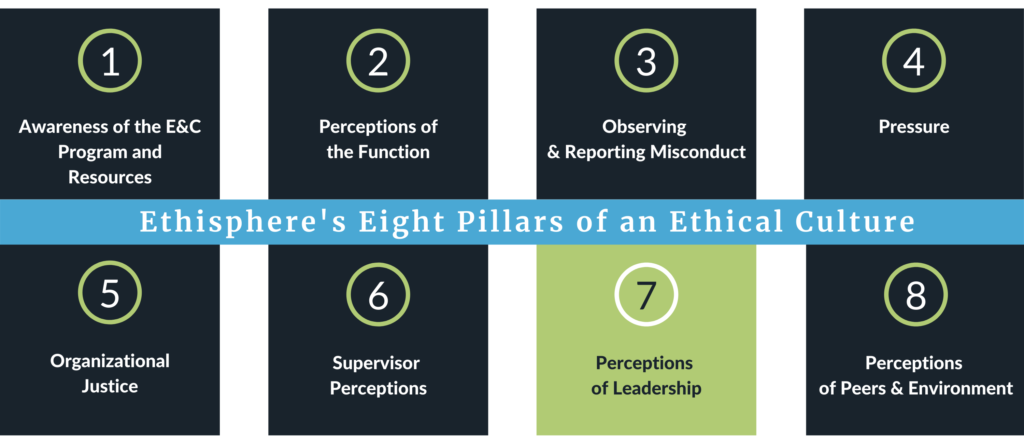
Pillar Seven: Perceptions of Leadership

What it is we aim to measure:

Employee perceptions of senior leadership, and whether leaders both “talk the talk” and “walk the walk.”   

Types of questions in the assessment:

  • Senior leadership promotes the importance of doing the right thing.
  • I believe senior leadership acts ethically.

Why it matters:

“Tone from the top” has always been a critical component of a strong ethical culture, and the extent to which the leadership team emphasizes and demonstrates the way in which they expect employees to behave will have ripple effects throughout the organization.

We see a significant delta when we compare the perceptions of those employees who believe senior leadership acts ethically to those who are not so sure, particularly on key questions like whether the company abides by its commitment to non-retaliation.

What the data says:

This pillar tends to be an area that strongly correlates with all other areas of culture measurement:

87 percent of surveyed participants believe that senior leaders promote the importance of doing business the right way

78 percent of survey participants believe that senior leaders act consistently with their words

That nine-percentage point gap is an area of opportunity for most organizations. What we generally find when we dig into the data is most employees do not actively disagree that senior leaders “walk the walk” – they simply do not have a reason to say one way or the other. This is particularly the case with geographically distributed workforces who may rarely see or hear from the leadership team.

How Ethisphere clients have used the data/insights:

Organizations often use the data from this pillar to review with leaders the extent to which they are engaging in storytelling when sharing goals with employees. Do they explicitly talk about ethical decisions they have made or how they might handle a given situation? If they do, does the data available to the company show that employees are hearing those messages? Many times, the leadership team thinks they are conveying messages, but it’s through a modality that employees are not using. Avoid this scenario by using available metrics to inform modality choices.

Expert tips for your program:

  • Verify that leaders are sharing stories, and celebrate those who do it most effectively.
  • Use the example of those leaders to inspire those to whom it comes most naturally.
  • Ask what metrics are available to monitor the modalities that employees are engaging with, and modify messages accordingly.

Have questions about ethical culture? Schedule time to talk with an Ethisphere expert.

Effectively Gathering and Making Use of Compliance Data

Effectively Gathering and Making Use of Compliance Data

This webcast explores how companies are digitally transforming compliance programs by leveraging data analytics and automation. The charge to create a data-driven and automated compliance program may seem daunting but with the right tools it can be made simple and effective. In this conversation, speakers take a closer look at trends in data analytics and share best practices on how companies are integrating their risk data, using it to make better decisions and measuring E&C program effectiveness.

Featuring:

  • Craig Moss, EVP, Ethisphere & Program Director, Digital Supply Chain Institute
  • Andy Miller, Chief Analytics Officer, Lextegrity
  • Shruti Shah, President & CEO, The Coalition for Integrity
  • Christopher Nelson, Assistant General Counsel, Head of Compliance Analytics, Microsoft

Keynote: Why Engagement Matters to the Lifestyles, Activities, and Experiences People Cherish Most

Keynote: Why Engagement Matters to the Lifestyles, Activities, and Experiences People Cherish Most

At the 2021 Virtual Asia Pacific Ethics & Compliance Forum, Winnie Ma, President, Greater China and Southeast Asia, VF Corporation, and her colleague, Becky Cho, VP, Corporate Affairs—Asia Pacific, VF Corporation, discussed accountability and the value of promoting a strong culture of ethics.


Featuring:

  • Winnie Ma, President, Greater China and Southeast Asia, VF Corporation
  • Becky Cho, Vice President, Corporate Affairs—Asia Pacific, VF Corporation

Keynote: Dell Technologies Computes the Impact Ethical Leadership Has on Corporate Culture

Keynote: Dell Technologies Computes the Impact Ethical Leadership Has on Corporate Culture

In this keynote session from the 2021 Asia Pacific Ethics Summit, Amit Midha from Dell Technologies speaks about Dell’s culture, ethical leadership, digital transformation, and much more.  


Featuring:

  • Amit Midha, President, Asia Pacific & Japan and Global Digital Cities, Dell Technologies