4 Minutes - Read Now
Pressure to adopt AI is mounting inside most organizations. Investors want to see AI mentioned on the earnings call. Boards want it in the strategy deck. Employees pick up on both signals and add one of their own: the fear of falling behind everyone else who has supposedly already figured this out.
At Ethisphere, we spend a lot of time studying pressure to compromise a company’s code, policies, laws, or regulations in order to hit business goals. It’s worth asking whether that same pressure now extends to AI. My read is that it does.
Under Pressure
The market rewards the appearance of AI adoption, sometimes more than the substance behind it. When Allbirds closed its retail stores and rebranded as NewBird AI, the stock jumped. That’s the kind of signal management teams notice, and it filters down. Meanwhile, workers are telling researchers something more complicated. HRDive reported that 1 in 5 workers feel pressured to use AI in situations they’re unsure about, and 1 in 6 admit they sometimes pretend to use it. CNBC found that 28% of workers avoid AI for moral or ethical reasons, and 37% cite privacy concerns. Employees feel pushed toward these tools from above and still carry real reservations about using them.
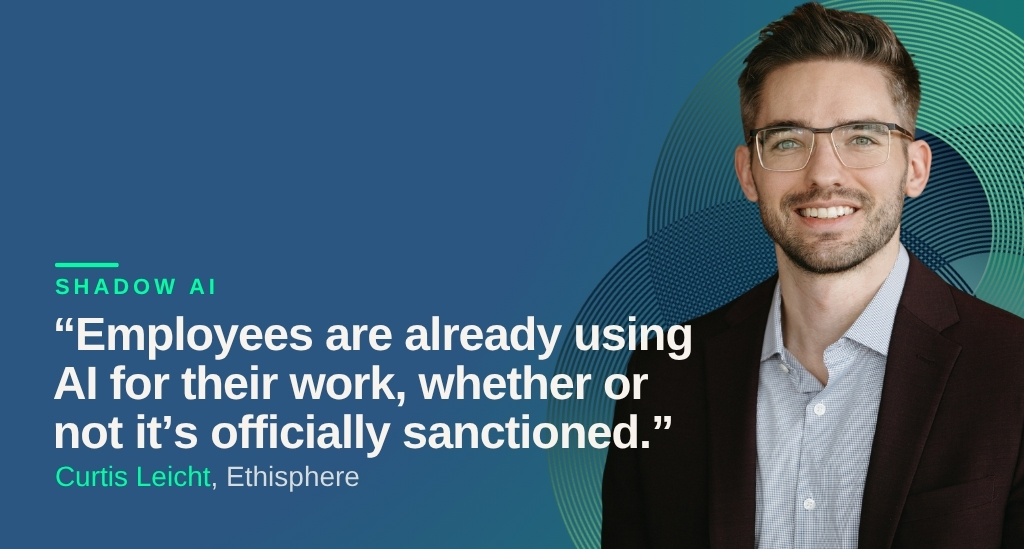
Compliance departments and their policies can’t keep up. Employees are already using AI for their work, whether or not it’s officially sanctioned. Some do it because they’re ambitious and want an edge. Others do it because leadership expects results without asking too many questions about how they got there. Employees stuck with locked-down company devices sometimes turn to free or personal AI accounts instead, exposing company or client information. This is the shadow AI problem: adoption that happens outside any system built to catch it.
Add a lack of clear guidance to that pressure and the risk compounds into real problems: data breaches, cyberattacks, other breaches of policy. These get harder to catch once AI agents are running inside an organization, because an agent acts without stopping to ask whether something is a good idea. The Cloud Security Alliance found that 53% of organizations surveyed reported AI agents exceeding their intended permissions, and 47% reported an actual security incident involving one. Those numbers describe systems already in production, not a hypothetical future risk.
AI & Culture Data
Ethisphere has measured ethics culture at organizations around the world for years and has more than 5 million survey responses to draw on. Pressure is one of Ethisphere’s 8 Pillars of Ethical Culture, and it shows up clearly in the data. In 2024 and 2025, 15.2% of respondents said they felt pressure to compromise their company’s code, policies, laws, or regulations to achieve business goals. Asked where that pressure came from, 32.9% pointed to senior leadership, 28% to middle managers, and 27.4% to immediate managers. Those three answers topped the list, which tells you the pressure employees feel starts at the top and moves down through the org chart.
That data lines up with what employees are describing about AI. They’re caught between direction from above and guidance that’s vague or missing entirely. Pressure, whether internal or external, paired with unclear AI rules forces a bad choice: use AI without any real way to manage the risk, or avoid it and slow down work that everyone else is being pushed to speed up.
Good policy can fix part of this, but only if it’s written the way employees actually read policy, which is quickly and under pressure, not the way legal teams tend to write it. Can an average employee open your AI policy and find the answer they need in a few minutes? Does it say where to send questions that aren’t covered? Is it reviewed often enough to keep pace with how fast the tools themselves are changing? A policy that answers those questions well gives your risk-takers a lane to work in and gives your cautious employees enough confidence to try.
Where Is Your AI Policy?
Vague or missing AI policy carries a real cost. Stories about AI agents overstepping their bounds, or employees misusing AI and causing a breach, are common enough now that they barely make anyone blink. Risk-conscious employees respond to that uncertainty by faking their AI use or avoiding it altogether when there’s no clear standard to follow. Either way, the organization loses the innovation and productivity it hoped AI would deliver in the first place. Are your AI policies creating the right environment for innovation?
Author Bio

Curtis Leicht | Data Analyst, Ethisphere
Curtis Leicht is the Manager of Culture Services at Ethisphere. He leads a team of Culture Analysts who guide Ethisphere clients through their Ethical Culture Improvement Journey. The Culture Team at Ethisphere specializes in providing bespoke survey and benchmarking solutions to measure and improve ethics culture for organizations around the world. The team also provides insights into global ethics culture trends, through analysis of over 4.5 million survey responses from 300+ organizations around the world. These insights help to drive program maturity and innovation in the Ethics & Compliance space.