8 Minutes - Read Now
As a member of the Ethisphere team, I get the pleasure of seeing and hearing a wide range of thoughts from our clients: I get to learn what’s on their minds, and I get to understand what is important to them. Some topics are trendy and leave as quickly as they arrive. Others are always around, but with a different flavor: ideas and innovations around reporting is one of those topics.
Recently, I had a conversation with an associate who was struggling with an issue. He is responsible for a fair portion of his company’s ethics and compliance function, and his speak up numbers were flat. Not up, not down, but flat—and for the third year running.
He’d done the work. Emails, articles, an internal “ethics week,” and 100% completion on annual training. He was innovating, too: using AI to flag reporting trends, automating parts of his hotline, and rolling out a mobile app so employees could report from their phones. None of it moved the needle.
Employees still worried about retaliation. They still weren’t calling the hotline in the numbers he’d hoped for. And when we looked at his engagement survey results, attitudes toward speaking up were, at best, lukewarm. He was close to writing it off. He’d done what the job called for, and if the needle wasn’t moving, that wasn’t on him.
It was time to shift direction and approach this by looking at it in a different way. But how? I brought up a method that yielded good results for other organizations: going back to fundamentals. New tools and clever automation aren’t the wrong instinct. But before an organization makes hasty decisions, it’s worth checking whether the fundamentals are actually solid. An organization needs to ensure that the things that make an employee willing to raise their hand in the first place are present.
If your speak up numbers are flat, and if you just suspect there’s room to do better or you just need a good “level set” (we all do once in a while) here are five basic questions worth asking yourself and applying to your program:
Do Our Employees Know Right vs. Wrong?
Most speak-up training walks employees through policy. Fewer walk them through judgment. There’s a real difference between an employee who can recite the anti-bribery policy from memory and one who can look at an unfamiliar situation, weigh it against what the company values, and think: This doesn’t sit right, I should say something.
That second kind of employee comes from a culture where leaders talk openly about gray areas, where managers model raising a concern instead of just approving one, and where company values show up in daily decisions rather than a poster in the break room.
Ask yourself: when employees run into something ambiguous—something the Code of Conduct doesn’t spell out line by line—do they have a strong enough sense of your organization’s values to know what to do? Or are they falling back on “nothing in the policy said I couldn’t?”
Do Our Employees Know How to Report?
I work with organizations all over the world, and in nearly every one, I get to talk to employees: from new hires to the CEO. As I’m doing my work, I get to ask questions and when it comes to speak up and whistleblowing, I make sure I ask a similar question: if you saw something, would you report it? The answer is almost universally a quick, confident yes.
You might be surprised that the follow-up is where things slow down. How would you report it? “I’d call the hotline” is the standard answer. But when I ask where that number actually lives, or how to access it, the response gets pretty vague pretty fast. When I ask someone to pull it up in front of me, more often than not it takes real digging, or they simply can’t find it.
Reporting an incident already takes real courage. Add doubt, fear, and a dozen reasons to stay quiet, and it doesn’t take much friction to make someone give up before they start. Do you really want an employee to abandon a report because they couldn’t find a phone number or a link?
Clear signage, a memorable name or tagline for the hotline, a variety of modalities, and messaging that shows up wherever employees already look all remove one more excuse to stop.
Do Our Employees Fear Retaliation?
In nearly every study on why employees stay silent, fear of retaliation lands as one of the top two reasons. Employees worry about the obvious (direct) kind: losing a job, missing a bonus, getting passed over for a promotion. They equally worry about the quieter (indirect) kind: getting frozen out by peers, losing the good assignments, becoming the person nobody wants on their project.
When retaliation comes up, the standard company response is some version of “we have a non-retaliation policy”, “we just sent a reminder email about it”, or “it was covered in our training.” That’s a start, but it does little to calm the nerves of someone actually weighing whether to speak up.
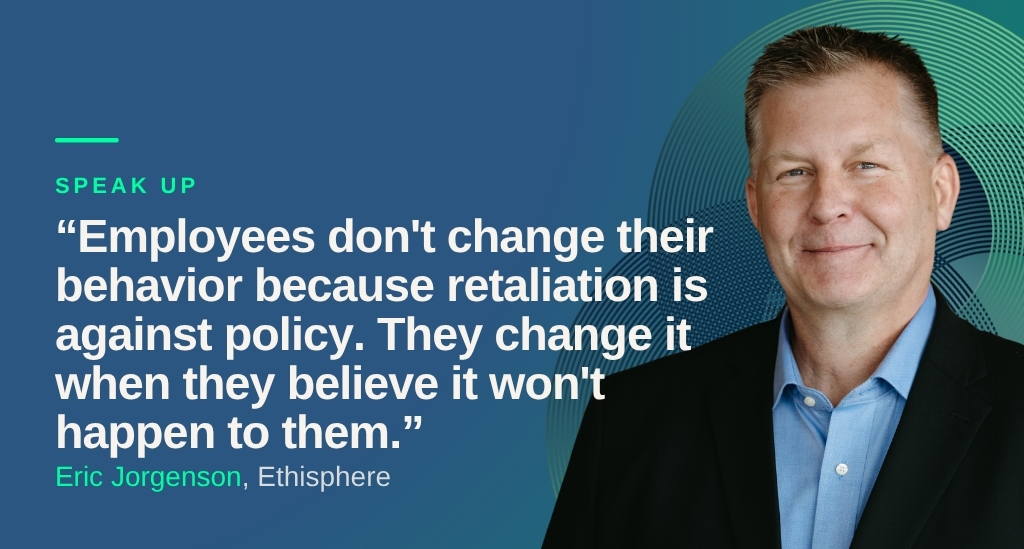
For a topic this sensitive, what really works is hearing it from a trusted person, in a live setting (if possible), and in plain language. A department leader saying, in their own words, that retaliation won’t be tolerated carries more weight than any policy reminder. Employees don’t change their behavior because they were told retaliation is against policy. They change it when they believe it won’t happen to them.
So ask yourself honestly: how have you actually communicated non-retaliation in your organization? And more importantly…do your employees believe it?
Do Our Employees Understand Their Speak-Up Expectations?
This one tends to spark real debate, and organizations land in different places, but it’s worth wrestling with. What do you actually expect of employees when it comes to reporting, and have you said so plainly? Read your Code of Conduct, your policies, and your internal communications. Are employees encouraged to report misconduct, or are they required to? The difference isn’t just semantics. These two words have vastly different meanings and the impression they leave on employees equally unique.
Picture an employee who thinks, but isn’t fully sure, that a colleague padded an expense report. If the policy language only encourages reporting, that employee has an easy out: they weren’t sure and since it’s not a requirement, they let it go. But if reporting suspected misconduct is a clear condition of employment, the calculation changes. The uncertainty that used to justify staying silent no longer holds up.
Each company has to determine their expectations for reporting possible misconduct and the tone they set for their speak-up culture. What is your company’s expectation and do the words and statements you use clearly reflect that?
Do Our Employees Understand Our Investigation Process?
Between reality television, true-crime podcasts, and social media accounts built around catching people in the act, employees today have more exposure to what they think an investigation should look like than any generation before them. So ask: have you explained the step-by-step investigative process to your employees? Does your workforce have a positive impression of how your organization handles a report of misconduct? Has your ethics and compliance team ever talked openly about what actually happens after someone submits a report? Is the investigative process built around what’s fair and workable for the people involved in the incident (the reporter, the witnesses, the accused), or is it built for someone else’s convenience?
In working with a wide variety of organizations, I’ve seen some eye-opening practices. One organization had an online hotline with 21 required fields to submit a claim. A different organization guaranteed a response to any hotline report within seven days. Another entity set a standard for completing interviews within 180 days of the case being opened. Other organizations had no requirement or practice for any sort of follow up with reporters or witnesses after the investigation was closed. For those required to complete the investigation, these standards (or lack thereof) seemed perfectly reasonable, but they left a negative impression on the employees involved in the investigations themselves.
An investigative workflow does more than organize a complicated process. It sets a standard that reaches beyond the people directly participating. Employees who are weighing whether to report need confidence that raising their hand triggers something fair, timely, and thorough, and that they won’t be left wondering what happened after they walked out of that first interview. When a workflow protects the organization’s convenience over the reporter’s experience, word gets around fast, and it undoes everything else the program has built.
Whistleblower programs, speak up culture, and investigations are foundational to any ethics and compliance program, and there’s real value in bringing new tools and ideas to strengthen them. But innovation only pays off once the fundamentals are solid. Before investing in the next AI tool or hotline redesign, sit with those five questions I discussed. The answers will shed a new perspective on your metrics and cause you to look at your practices with a different perspective.
Author Bio

Eric Jorgenson, M.P.A | Director, Data & Services, Ethisphere
Eric is a Director on the Data & Services team at Ethisphere and specializes in the Ethics & Compliance program management, specifically the evaluation and implementation of corporate compliance and ethics solutions. His work includes evaluations of client programs, assessment of programmatic components, and operational thought leadership for clients.