12 Minutes - Read Now
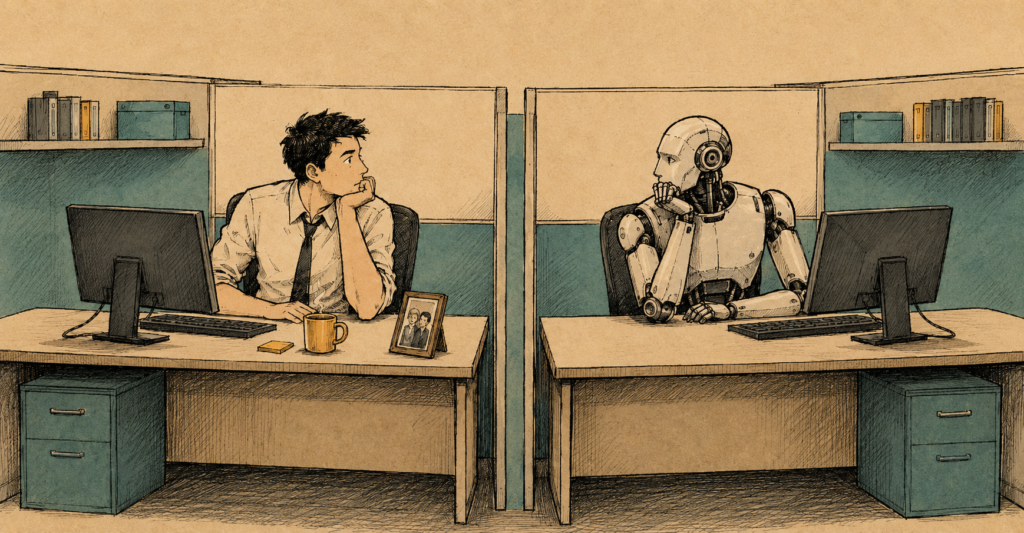
Artificial intelligence has redefined our business context. Every person and every organization must ask, “How should we think about this and what should we do?” And that’s no AI prompt; we must answer those questions ourselves.
Things are far from perfect because we’re still figuring it out. Part of the problem is that a lot of attention (and money) has gone into the technology, but not the people it’s intended to help. Allowing AI to dictate the direction for humans and not the other way around is like the proverbial tail wagging the dog. So while everyone talks about being left behind by themselves, the real risk comes from leaving all of us behind.
Our businesses are not made of machines. By definition, an organization is still its people. But for many companies, the struggle with integrating these fast moving technological advances with their workforce is real. So long as humans remain in the loop, we solve this not by trying to keep up with AI, but by leaning into the parts that are uniquely human and cannot be replaced by technology. And, by balancing the ratio between human and technology contributions for individuals, teams, organizations, and even society itself. A human-technology quotient, if you will.
How Should We Think About This?
Whatever terminology we choose—interpretation, sense-making or meaning-making, understanding, discernment—they all point to the fact that technology can’t experience life the way we can, and therefore cannot decide what it means to us. AI can be a collaborator, but as humans, we retain a “narrative responsibility” to evaluate and shape the story…just like in other parts of our lives.
Healthcare (which AI will never need, but humans always will) is a perfect example of how this dynamic plays out. While technology is key to improving human health, healthcare and AI are based on two different mental models. Health systems optimize for predictability, auditability, and rule-based control. AI, on the other hand, is a probability engine that operates in the realm of statistical reasoning, emergent behavior, and ambiguity. Where AI moves from a bolt-on feature to a true paradigm shift is when the two become an integrated, coordinated system that provides access to the best of both mental models for better, safer outcomes.
Beyond healthcare, every sector has been challenged to navigate the bridge between old and new ways of work thanks to AI. Leaders must quickly level up their own technological know-how, set the company’s strategic vision and direction for AI, and effectively incorporate AI-generated insights into their decisions, all while continuing to lead in ever-deepening complexity. Meanwhile, massive investments in this technology, along with coinciding leadership mandates to make use of it, leaves employees required to use AI to enable and enhance their work. As our new business context evolves, so too does our work.
What should we do?
Leading intentionally in the Age of AI begins with establishing a human-technology quotient that summarizes the deliberation and the boundaries of AI-led, human-led, and shared spaces within a cohesive, integrated system. The efforts here are woefully anemic and no real industry benchmark exists across the board. Because every organization is unique, the empowerment and responsibility to do this remediation work can start now.
Learn
AI integration in our new work context exposes new skill gaps and exacerbates old ones as well. Case in point: Atalassian CEO Mike Cannon-Brookes recently laid off 10% of his workforce to fund investment in AI. “It would be disingenuous to pretend AI doesn’t change the mix of skills we need or the number of roles required in certain areas,” he said of the move. “It does.”
It’s foolish to try to keep up with all the data AI can process, nor can we simply rely on studying and being book smart. The uniquely human kind of learning that we are talking about is what the Electronic Discovery Reference Model (EDRM) website refers to as experiential-based intelligence, which “is what enables humans to derive meaning, context, and emotional depth from their interactions and decisions…beyond mere processing of raw data.”
Instead, we must invest in our human potential. My Consortium for Change (C4C) colleague, coach and cognitive scientist Phillip Campbell promotes fluid thinking through four pillars:
- Controlling attention for deep, optimized focus,
- Complex problem solving using different thinking styles (analytical, innovative, and conceptual),
- Strategy, planning, and execution for implementation, using strategic, abstract, and operational thinking,
- Social leadership to build rapport, trust, and followership through nonverbal, perspective, and intuitive thinking.
We can put these cognitive abilities into practice with learning agility, which scholar and thought leader practitioner W. Warner Burke, PhD defines as “what we do when we don’t know what to do.” He and co-author David Hoff identified 9 dimensions of learning agility: Flexibility, Speed, Experimenting, Performance Risk Taking, Interpersonal Risk Taking, Collaborating, Information Gathering, Feedback Seeking, and Reflecting. Honing these key human capabilities is even more critical to fulfilling our human responsibilities in an ever-changing, volatile, and complex world, regardless of our roles.
Organizations must do this at scale or risk wasting their investments in AI and the future of their business. Where I’ve seen training budgets whittled down to just executive leadership development and team off-sites, more must be done to ensure our workforces are future-ready, including the allocation of resources and the opportunities to use our human capabilities. This is a right-now issue because it’s clear that organizations are struggling. The massive layoffs aren’t just about moving money toward AI and job replacement, they are an indicator that we are failing to develop and optimize our talent. The immediate action is to balance the investment in developing our workforces alongside our AI investments because we need to leverage human potential and experiential-based intelligence to make the integration work.
Set the Standards
Learning also enables us to better fulfill our meaning-making and narrative responsibilities. In practical terms, we articulate our interpretation by way of thoughtful, effective, and enforceable AI standards that incorporate and reflect stakeholder POVs, ethics, and values with their requisite framework, infrastructure, and processes to ensure both accountability and adaptability.
Though there are some examples of AI standards and governance that continue to be developed, it’s been like building an airplane while it’s flying—largely improvised and only covering the bare necessities. This work requires a lot more rigor and discipline than what we’ve seen. We should think of technology development like we do for the development of food and drugs—for safe human consumption. It’s that important. And where the standards don’t exist, there is a responsibility to take initiative and lead.
Connect
AI cannot integrate us all together. We are the connectors. We know that our capacity to connect with one another is special and what helps us to thrive. This is a kind of relational responsibility where we are responsible for our actions to others. Now more than ever, we must double down on the relational responsibility to connect.
Relationships can be transactional, characterized by give-and-take, ask and answer. Transactions don’t support bonding. Connection, value, and influence come from transformational relationships, ones built on demonstrating empathy, engagement, and commitment to one another.
Deeper relationships require genuine dialogue and strategic conversations. Unlike debate or discussions, dialogue is a true collaboration, one where the value exceeds the effort. We each bring our contributions, and our job is to figure out how they might synthesize to bring about greater understanding, meaning, and results.
There’s not an organization that doesn’t need more trust, greater engagement, and stronger relationships in its workplace. If connection is lacking, then we must either build it or learn how to build it. If the capacity is there, but it needs more encouragement, that’s when organizational culture comes in.
Cultivate Culture
AI can’t replicate culture for us because it’s about human connection at scale. While AI has certainly influenced mindsets and behavioral patterns, it’s still our responsibility as organizations to define who we are and the values we stand for through our culture. Why? Because it is what distinguishes people from technology and organizations from each other. A healthy culture encourages trust, adaptability, resilience among people, and even drives innovation. A toxic one does the exact opposite. Companies are making the choice every day of whether their culture is a corporate asset or liability.
Both the challenge and the solution for integrating AI are also dependent on culture. The technology is new, but the human issues are not. Whether a culture can handle and support disruptive change determines success or failure. Declaring “We’re an AI company now” (as I’ve heard some do) is meaningless if it’s not backed by a culture that aligns technology with what matters most. In other words, AI should be working in service of these core values, not the other way around.
As Sherri Douville and TTIC explain, high-functioning AI cultures:
- Encourage cross-disciplinary respect between engineers, clinicians, governance leads, and product teams
- Reward escalation and ambiguity-resolving behavior
- Train for probabilistic reasoning, not just deterministic execution
- Empower individuals to ask, “What if we’re wrong — and how would we know?”
This doesn’t happen on its own. Culture work requires a commitment to intentionally design, develop, implement, and sustain it. Entropy is a real risk; a culture that goes unmaintained inevitably deteriorates.
My framework, the Design of Work Experience (DOWE), provides the step-by-step “how to,” combining human-centered design with the process of change.
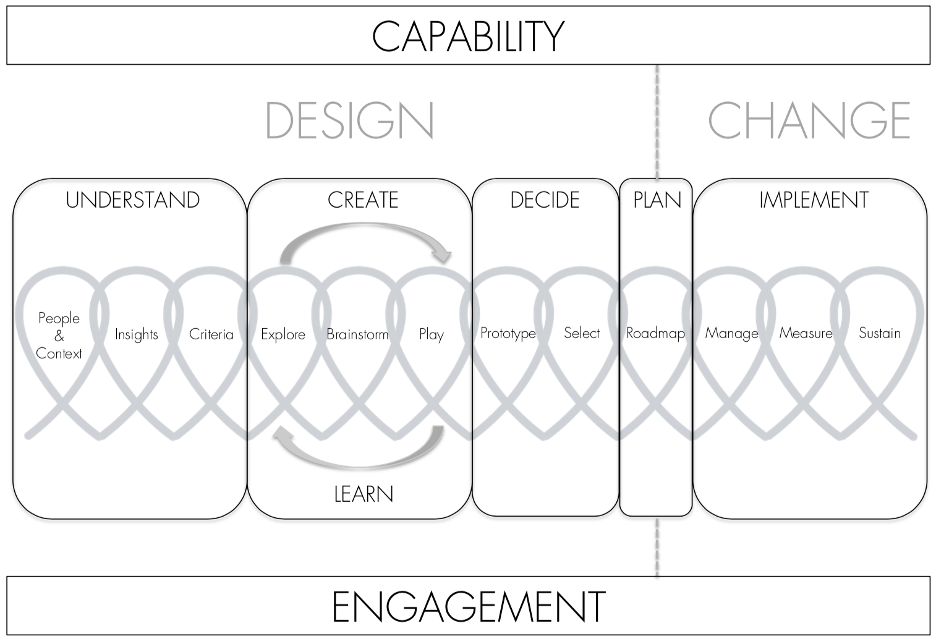
Culture has already been neglected for far too long in many organizations, and we have the record-low morale to prove it. With AI in the picture now, that can’t continue. As it relates to AI, the culture work to be done includes readiness for change and adoption, enabling both people and the business to thrive.
The “So What?” and Next Steps
To borrow from systems thinking, we are part of a whole system made up of many different interconnected and interdependent parts. A change in one area has a knock-on effect throughout. Some create smaller ripples, others create big waves. And AI, no doubt, is a big wave.
Our job is to prevent, fix or remake what’s broken, so that we can align, connect, integrate, and sustain success with AI, people, and the organization. AI is the catalyst, but it can’t do this for us. It’s our responsibility to use our innate gifts to make meaning, learn, structure, and relate to each other and with technology. That’s how we accelerate and avoid being left behind. To cede or abstain from our authority and agency here would be irresponsible and in time, could lead to our own incompetence.
We must take the lead within our organizations and do what it takes to determine our human-technology quotient, integrating our people ourselves and with our technology. And we must build a stronger future with capable talent who can navigate strategies, set standards, and connect within healthy ecosystems.
- Start today with dialogue-driven strategic conversations that focus on our strengths, opportunities, our aspirations, and desired results (SOAR) to reset our relationship with technology and better integrate AI into our organizations.
- Create a new vision for AI within our organizations that incorporates our understanding, establish and keep to standards that reflect our roles and our values.
- Manage our cultures as a differentiating asset and the connective tissue of the organization that it is, starting with a baseline of where we are today to identify gaps between the current state and the desired future. We deliberately design, develop, implement, and sustain organizational cultures that align with our business and AI strategies.
- Follow through with executional excellence, which includes closing loops, absorbing friction, resolving conflict, making tradeoffs stick, and delivering outcomes on time.
Policies, systems, and culture shape organizational life, but it is built upon the actions people take every day. So here’s the next steps for you, the individual leader:
- Integrate the human experience into conversations around AI, informally and formally, from “how are you finding these changes?” at the water cooler to agendas in meetings, and good faith responses to employee engagement surveys. Look for themes that need to be addressed, not just usage numbers. Identify specific behavioral patterns in yourself and others to encourage or discourage—these are the basis of your culture. Revisit your team charters, group agreements, and playbooks—including purpose, principles, processes, and norms to make them intentional and overt.
- Pay attention and follow up. It sounds simple, but this is where many leaders fall short every day. Working as fast as they do, they fail to notice until it’s too late. Who is becoming friendlier with their chatbots than they are with their own co-workers? Are people asking for each other’s opinions? What stories are people sharing about the technology and each other? Connect with colleagues beyond the progress of their work. Role model the behaviors you want to see when it comes to adapting and integrating AI into work life. Strategize and facilitate the narrative you want to see play out.
- Set aside the resources within your influence to develop your team dynamic and the capabilities of your people to support AI adoption. Bring in human coaches to supplement what AI might be advising, especially for those related to complex dynamics and relationships, including for yourself.
Do we continue down our current paths or take a different direction to connect the fractured pieces in our working relationships and our organizational culture? It’s our choice, and ours alone. We must make it intentionally. Our future depends on it.
Author Bio

Karen Jaw-Madson | Principal of Co.-Design, Work Experience, Guest Contributor
Karen Jaw-Madson is principal of Co.-Design of Work Experience, author of Culture Your Culture: Innovating Experiences @ Work (Emerald Group Publishing, 2018), founder of Future of Work platform A New HR, instructor at LinkedIn Learning after teaching at Stanford University’s Continuing Studies Program.