5 Minutes - Read Now

Lighthouses were built to be seen when it matters most. When fog rolls in, seas change, and familiar landmarks disappear, a steady beacon becomes a decisive advantage. It signals hazards and helps crews hold a reliable course when conditions are shifting.
What’s true in coastal navigation also holds true in business ethics: At all times—but especially in volatile, uncertain, complex, and ambiguous (VUCA) environments—an organization needs guidance to chart a successful course. And that guidance has to come from the top.
How tone at the top shapes organizational ethics
Today’s rapidly evolving business landscape requires top leaders to guide their organization’s ethical culture through visible actions, indelible messages, and unwavering commitment. As introduced in Deloitte’s “Leading with ethics,” the first of the four elements of ethical leadership—Ethics Expression—underscores the CEO’s and executive team’s responsibility to light the way on integrity and quality in workplace culture.
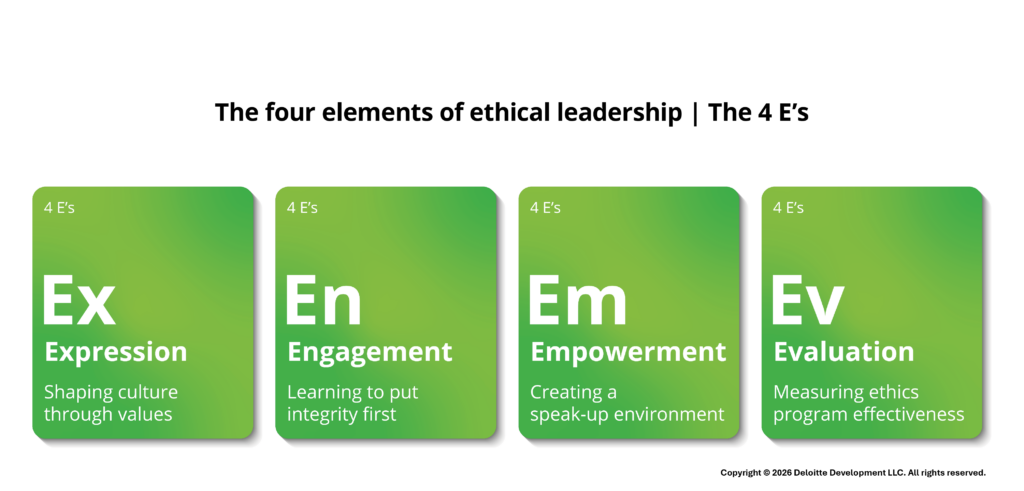
Ethics Expression is the deliberate, consistent communication of organizational values and ethical standards, coupled with explicit expectations for employee conduct. As with sailing, it’s not enough to assume the correct course is clear or intrinsically understood. Executives need to model what ethical behavior looks like, why it matters, and how it aligns with the organization’s mission and long-term success.
This is why tone at the top cannot be treated as a one-time message or a leadership slogan. Leaders need to signal the culture they want to see, and that starts with tone and messaging.
Data shows that this matter may merit urgency. Findings from the Ethics & Compliance Initiative’s Global Business Ethics Survey (as reported in “The State of Ethics & Compliance in the Workplace—United States Trends”) indicate that when employees perceive a weak ethical culture, they are four times more likely to feel pressure to compromise standards than those who perceive a strong ethical culture.1 A clear ethical tone at the top can help reduce the risk of misconduct, regulatory breaches, and reputational damage because employees are less likely to rationalize unethical behavior when leadership’s expectations are explicit and non-negotiable.
‘Lighthouse lessons’ for setting the tone
To help their organizations chart their own ethical course, leaders can rely on the same key insights that lighthouses use to keep ships safe.
Lighthouse Lesson 1: Illuminate the way
Like a lighthouse’s constant beam, leaders should vigorously and consistently communicate that integrity is foundational to their values and to how the organization conducts business. The CEO and executive team should convey that acting with integrity is as important as business outcomes—and that it is the responsibility of every person in the organization. At the same time, leaders should ensure the organization has the right people and infrastructure to cascade these messages to all levels and to convey consequences of ethical lapses, so the workforce knows what’s expected and what can happen if they stray off course.
In practice, leaders can reinforce this by “walking the talk”—modeling ethical behavior even when it is challenging or more costly—and by de-mystifying decision-making, explaining the rationale behind difficult choices to show how organizational values guide actions.
Lighthouse Lesson 2: Always be accessible
A beacon’s brightness matters. Perhaps more important: that it can be seen. A lighthouse’s strength is its reliable presence. To be most effective, leaders should ensure their values shine throughout the organization uninterrupted, reaching people where they are, in formats that work for all employees, across a variety of contexts.
Leaders should reinforce that their doors are open, actively listen, welcome concerns regardless of title, and periodically sit with teams to discuss ethical challenges and celebrate ethical wins. They can scale this through technology (e.g., video messages, virtual town halls, collaboration platforms) and storytelling that highlight successes and lessons learned in real examples of ethical decision-making.
Lighthouse Lesson 3: Adjust to changing conditions
Just as lighthouses modernize without abandoning their purpose, ethics messaging should adapt as the workforce evolves, hybrid work persists, and AI and other advances transform organizations, with standards and expectations reinforced as non-negotiables.
Amid so much change, leaders should consider how they identify and address evolving risks—and whether their ethics messaging should shift to keep lighting the correct course. In practice, that can include monitoring culture through tools such as pulse surveys to gauge the ethical climate, identify trends, and understand emerging risks, then evolving communication in response, with effectiveness gauged through Ethics Evaluation, another of the 4 E’s.
Summary
The CEO and executive team serve as beacons of their organization’s ethics; ethical leaders embrace that responsibility and set high standards for themselves, even in the face of opposition or personal cost. The 4 E’s of Ethical Leadership show that by prioritizing Ethics Expression, executives set the course for a culture where integrity is not just expected but celebrated.
When leaders want to keep their ships sailing safely, it’s up to them to light the way.
Sources
- Ethics & Compliance Initiative, “The State of Ethics & Compliance in the Workplace—United States Trends,” 2024, p. 11.
As used above, Deloitte refers to a US member firm of Deloitte Touche Tohmatsu Limited, a UK private company limited by guarantee (DTTL). This article contains general information only, and Deloitte is not, by means of this article, rendering accounting, business, financial, investment, legal, tax, or other professional advice or services. This article should not be used as a basis for any decision or action that may affect your business. Before making any decision or taking any action that may affect your business, you should consult a qualified professional advisor. Deloitte shall not be responsible for any loss sustained by any person who relies on this article.
Excerpted from an article originally published on Deloitte.com. Read the full report and watch Deloitte.com for additional content exploring the 4 E’s and other ethics topics. © 2026 Deloitte Development LLC. All rights reserved.
Author Bio

Lori Pressler | Chief Ethics Officer, Deloitte LLP, Guest Contributor
Lori is an audit Partner at Deloitte with over 25 years of experience serving domestic and global clients. She serves as the Chief Ethics Officer for the Deloitte US firms and as a National Professional Practice Director for the Audit & Assurance Practice.

Michael Rossen | Managing Director, US Ethics Office, Deloitte, Guest Contributor
Michael is a managing director in Deloitte’s US Ethics Office. He is focused on implementing and overseeing programmatic approaches to elevate the organization’s ethics culture, supporting Deloitte’s unwavering commitment to integrity, trust, and quality. He has 25 years of Deloitte experience advising clients on complex matters encompassing ethics, integrity, compliance, organizational culture, risk, forensic investigations, crisis management, and corporate governance.

Miira Velia | Managing Director, US Ethics Office, Deloitte LLP, Guest Contributor
With over 25 years of experience in ethics, compliance, and regulatory affairs, Miira serves as a managing director in Deloitte’s US Ethics Office. With a mission to foster an ethical culture throughout the organization, she develops and manages strategic initiatives designed to support Deloitte’s commitment to integrity. Miira also oversees critical Ethics Office operations, including ethics policy management and investigations and case management, and she provides strategic guidance on ethical risk management.