8 Ways to Elevate Ethical Culture: Measuring Business Pressure and Risky Growth Targets

8 Ways to Elevate Ethical Culture: Measuring Business Pressure and Risky Growth Targets

AUTHOR:
Erica Salmon Byrne, J.D.
Executive Vice President and Chair of the Business Ethics Leadership Alliance (BELA)

In this series, we share insights into the eight pillars that make up a robust ethical culture. Our eight pillars seek to get at the key metrics of a strong ethical culture: Do your employees understand what is expected of them? Do they know where to go if they have questions? And, if they need help or have made a mistake, do they trust the process enough to go through with it?

In our previous posts, we’ve discussed:

Today’s post focuses on the pressure to compromise company standards in the pursuit of achieving business targets.

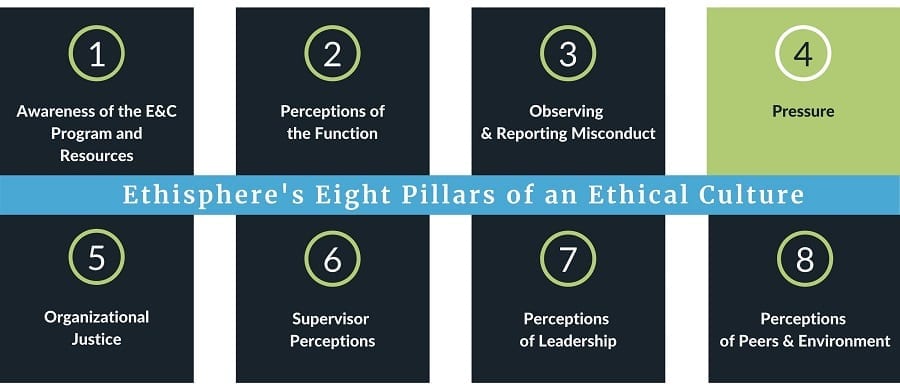
PILLAR FOUR:

Pressure

What we aim to measure:

In this Pillar, we measure the strength and source of pressure employees may be experiencing to compromise standards to hit goals. Does the “what” matter more than the “how” within the organization? Are employees encouraged to circumvent standards to achieve business objectives? And if yes, by whom?

Types of questions we ask:

  • I feel pressure to compromise the Company’s Code, policies, laws, rules or regulations in order to achieve business goals.
  • I feel this pressure from my senior leadership, middle management, immediate managers, coworkers, customers, or business partners.
  • The type of pressure I feel is strong, weak, or moderate.

Why it matters:

In a push for profits, an organizations can sometimes unintentionally elicit risky behaviors that are unethical and illegal. An organization that emphasizes results ‘at any cost’ lives on borrowed time. Organizations that encourage and reward efforts to achieve business objectives while adhering to the company’s values and legal obligations set the stage for sustainable operational excellence.

What the data says:

This pillar tends to be an area that reveals critical insights and opportunities for improvements. According to our data (of more than 1 million responses):

15 percent indicate they experience pressure to compromise company standards or the law in order to achieve business goals

58 percent that do experience pressure indicate the pressure has a strong or moderately strong influence on their decision making

Participants experiencing pressure most frequently cite Senior Leadership (38 percent) and their Immediate Manager (37 percent) as the source(s) of the pressure

The key takeaway from these statistics is that organizations – specifically, leaders within the organization – may unwittingly partake in committing the sin of omission, not commission. Rarely are senior leaders or managers explicitly stating that employees should achieve their business objectives by whatever means necessary. However, often missing in directives is the encouragement to achieve objectives in accordance with company standards.

The bottom line: When organizations reward performers (either through promotion or bonuses), that implicit pressure can lead employees to make compromising decisions that allow them to meet their targets.

How Ethisphere clients have used the data/insights:

Managers play a big role in how employees work to achieve their objectives. Quite often, managers who are not talking about how to achieve objectives in the right way aren’t opposed to doing so – they just see it as someone else’s job to share that part of the message (looking at you, E&C professional).

In other cases, managers are instigators of bad behavior, particularly in regions where actions, such as bribes, are an accepted norm.

Our clients use numbers like these to drive home the message that this is everyone’s job. When talking with managers, E&C teams emphasize that conversations around goals and objectives has to include reminders that the way in which something is done matters just as much as whether it is accomplished. They also share communications and tactics to support this message.

An individual company’s approach to addressing this challenge will vary by industry, since the potential sources of pressure can be different. For a tech company, pressure may come from a customer like a reseller or distributor. In retail or hospitality, customers are often a source of pressure, and the response there may be to deploy de-escalation training to help employees deal with overzealous guests asking for upgrades to which they are not entitled.

Once a company is armed with their data, identifying how to support employees who are feeling pressured or ways to remove the pressure with better communications becomes an easier exercise. (Note we don’t say easy. Just easier. This pillar is always a challenge).

Expert tips for your program effectiveness:

  • Celebrate moments where an employee elects to do the right thing and protect the organization’s reputation versus making a sale by unethical means – preferably in front of colleagues if possible. Public praise matters.
  • Encourage executives to emphasize the substance behind performance, not just the performance itself.
  • Train managers to observe and calibrate their response to failure. What is their reaction when someone brings bad news? It will influence whether they share again.

Have questions about ethical culture? Schedule time to talk with an Ethisphere expert, or subscribe to our “Culture Corner” newsletter to stay up-to-date on ever-changing culture trends and data.

Subscribe to “Culture Corner” >

8 Ways to Elevate Ethical Culture: Observing and Reporting Misconduct

In this series, we share insights into the Eight Pillars that make up a robust ethical culture. Our Eight Pillars seek to get at the key metrics of a strong ethical culture: Do your employees understand what is expected of them? Do they know where to go if they have questions? And, if they need help or have made a mistake, do they trust the process enough to ask for it?

In our previous post, we discussed the first of the eight markers: Do your employees understand what is expected of them? In the following post, we covered the second pillar: How employees perceive the effectiveness of ethics and compliance communications and training?

In this post, we focus on the culture of observing and reporting misconduct.

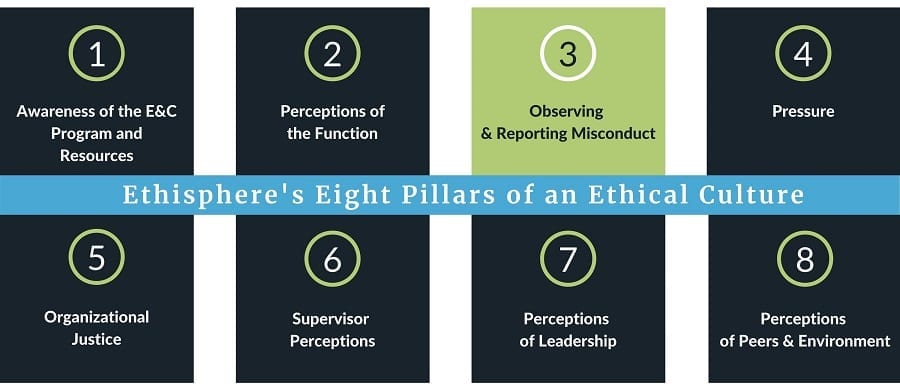
PILLAR THREE:

Observing and Reporting Misconduct

What we aim to measure:

This section addresses several important challenges: What is the strength of your organization’s “speak-up” culture? Do obstacles exist that prevent employees from stepping forward? If so, what might they be?

Types of questions we ask:

  • If I were to observe misconduct, I would be willing to report it.
  • Over the past 12 months, have you observed unethical behavior or business misconduct at the Company?
  • I reported the unethical behavior or business misconduct that I observed.
  • The Company has a policy that prohibits retaliation against employees who report misconduct or participate in an investigation.

Why it matters:

Mitigating people-created risk is key to the success of any Ethics & Compliance program. Establishing a culture where employees are comfortable raising concerns about suspected misconduct (intentional or accidental) is critical in that endeavor. In almost every instance of consequential misconduct, “somebody knew what was going on,” but many don’t speak up for a number of reasons, including fear of reprisal.

What the data says:

For the companies we work with, this pillar often offers significant opportunities to improve, particularly when it comes to levels of comfort in reporting observed misconduct. The data shows that:

92 percent of participants indicate a willingness to report misconduct if they were to observe it, hypothetically speaking, yet just 52 percent of employees who observed misconduct in the past 12 months reported the matter; with

60 percent of those individuals who did report a concern raised it with their immediate manager.

76 percent of participants believe that their company enforces its non-retaliation policy while 85 percent believe their manager complies with the policy.

The key takeaway from these statistics is that employees inherently believe they’d do right thing if misconduct occurs, however when faced with misconduct, many did not. As a result, it is incumbent upon the organization to foster a culture that allows employees to act on the instinct of ‘doing the right thing.’ Given that employees most often report to managers, it is vital to ensure that managers are properly equipped to navigate how to respond when a direct report raises a concern, who to go to for help, and how to prevent retaliation.

How Ethisphere clients have used the data/insights:

In our deep dives of the data, we have been able to identify micro-cultures that exist across an organization. These micro-cultures are heavily influenced by regional and functional differences.

Taking this data and cross-referencing it with demographic data, we are able to establish context for the strength of the “speak-up” culture. These insights enable organizations to identify opportunities for targeted manager training and functional communications to ensure the central ethos of the organization permeates all micro-cultures and that all employees feel comfortable using their voice.

Expert tips for your program effectiveness:

  • Leverage manager toolkits and discussion guides that encourage discussion at the local levels about the responsibility every employee has to protect the organization and ensure business is conducted properly.
  • Proactively set expectations for the reporting and investigation processes for all employees about what to expect if they unfortunately find themselves in a position where they’ve observed misconduct.
  • Publicize the investigator code of conduct and consistently communicate the company’s non-retaliation policy (and enforcement protocols).

Have questions about ethical culture? Schedule time to talk with an Ethisphere expert, or subscribe to our “Culture Corner” newsletter to stay up-to-date on ever-changing culture trends and data.

Subscribe to “Culture Corner” >

Lextegrity Masterclass Series, Class 3

Practical Data Analytics: Deep Dives Into Specific Use Cases

On-demand learning sessions for ethics & compliance leaders looking to leverage data analytics to improve programs, brought to you in partnership with Lextegrity.

DOJ guidance recommends using data analytics for monitoring, third party management, acquisition integration and other uses to enhance a compliance program. In this masterclass series, join Ethisphere and our partner Lextegrity to learn about data analytics, how to identify relevant data, ways to generate compliance value from data and how to avoid common pitfalls.

ON-DEMAND CLASS 3
Practical Data Analytics: Deep Dives Into Specific Use Cases

  • Transaction Risk Scoring
  • Third Party Risk Management
  • Risk Assessment
  • Investigations
  • Program Assessment / Individual Performance Assessments
  • How can I leverage machine learning and AI?

Related Resources

BELA M&A Playbook Exec Summary

M&A Playbook for Ethics and Compliance Leaders: an Executive Summary

In light of the many business disruptions during 2020 and the anticipation of a possible increase in merger and acquisition activity on the horizon, Ethisphere enlisted the members of the Business Ethics Leadership Alliance (BELA) as well as its own experts to create the M&A Playbook for Ethics and Compliance Leaders.

Related Resources

Ethisphere’s 2021 Global Ethics Summit Spotlight Tournament

Ethisphere’s 2021 Global Ethics Summit Spotlight Tournament

AUTHOR:
Sean Freidlin
Director of Strategic Marketing

Our 2021 Global Ethics Summit is loaded with talented speakers and thoughtful discussions of top issues for teams focused on ethics, compliance, culture, and risk, but which topics will make it onto your event agenda?

The good news is that you don’t have to choose – everything is available live and on-demand for registrants. But in the spirit of friendly competition within the community, we’ve created a tournament featuring 32 options from our agenda to find out what topics are most exciting to GES attendees and E&C professionals.

Voting is not a formal registration for the event, but it is a fun way to think about what your biggest priorities are for 2021 and beyond! The first round of the “Summit Spotlight’ Tournament begins on March 9th, progressing each week and concluding on April 9th with one definitive topic that our community is most excited to learn more about at the Ethisphere 2021 Global Ethics Summit, completely virtual for the first time ever.

Cast your votes using LinkedIn and Twitter to let your voice be heard, or visit our Summit Spotlight survey to pick your winners for the first round of voting. Track round by round progress and see every matchup in the bracket below.

To see our full agenda and sign up for tickets, visit https://globalethicssummit.ethisphere.com/agenda-2021 and use the code “tournament” for 15% off your ticket.

About the 2021 Global Ethics Summit

Ethisphere, a global leader in defining and advancing the standards of ethical business practices, today announced that the 12th Annual Global Ethics Summitwill take place virtually April 13-15, 2021, and this year’s innovative digital experience will improve on previous years.

To learn more and to register, visit https://globalethicssummit.ethisphere.com

Ethisphere’s annual Global Ethics Summit is the premier place for companies and delegates to learn, develop, and share ideas that elevate the field of business ethics and compliance. This year’s Summit will showcase more companies and feature additional points of view while bringing together a larger community of leaders. This year’s Summit will provide attendees, faculty, and sponsors with 50+ hours of content, interactive workshops, and on-demand content for all company leaders throughout 2021.

“A virtual Summit presents an exciting moment for us with a completely new blueprint for remodeling our flagship event—one of the most important in its field. While there is no replacement for the relationships developed in person, a professional digital experience will improve upon the ways we can distribute shared knowledge and support a larger base of leaders,” said Kevin McCormack, Senior Vice President and Executive Director of the Business Ethics Leadership Alliance. “Our 2021 theme acknowledges more than a year of unprecedented challenges, and it will feature companies that are leading a surge of spirit and solutions to become better and more capable on the other side of the pandemic. This could be our most important Summit yet.”

In an effort to build upon Ethisphere’s tradition of offering one of the most compelling platforms for leadership connectivity and diverse, pan-industry voices, Ethisphere also assembled the 2021 Global Ethics Summit Advisory Committee, consisting of transformational companies who have modeled an earnest commitment to raise the bar for global integrity.

“The global pandemic combined with the social and racial injustices we witnessed in 2020—and the real-time challenges confronting the business community to respond appropriately—make the 2021 Global Ethics Summit more important, practical, and meaningful than ever before,” said Lucy Fato, EVP, General Counsel & Global Head of Communications and Government Affairs, AIG, and Global Ethics Summit Advisory Committee member. “The events of the past year have permanently codified that risk responsibilities, vulnerabilities, and accountabilities exist everywhere in the corporate world, which is why hearing about experiences directly from company leaders is so valuable. These leaders will share what they’ve learned, where they’ve had successes, and where they’ve fallen short. We all want to do our very best as we strive to navigate a completely changed world.”

“Operating in a digital world is not new for LinkedIn, but the pandemic has forced us and every other business to re-evaluate how we do business in a digital economy. It’s certain that the transformation of our economies, politics, and society as a whole will no doubt influence the regulatory and compliance landscape in unprecedented ways,” said Amyn Thawer, Vice-President, Global Compliance and Integrity, LinkedIn, and Global Ethics Summit Advisory Committee member. “In addition to the challenges, there also opportunities to be uncovered. As part of the 2021 Global Ethics Summit’s Advisory Committee, I’m delighted that we’re exploring new and novel ways to share insights and best practices at scale. Including more leaders than ever before will undoubtedly help us cross-pollinate ideas and solutions and improve our leadership in these unprecedented times.” 

Mike Kolloway, SVP, and General Counsel, Parsons Corporation, and Global Ethics Summit Advisory Committee member said, “A strong ethical foundation is critical to business success and growth. As a global company, Parsons often deals with complex situations that could impact our reputation and business without a strong commitment to ethics, integrity, and compliance. I am excited to join the Global Ethics Summit Advisory Committee, and, along with my fellow board members, I am committed to advancing best international practices in the compliance and ethics arena. Companies can maximize the 2021 Global Ethics Summit’s digital platform to participate in interactive knowledge-sharing sessions, supplemented with on-demand content throughout the year—more than ever, it is this continuous engagement that we rely on. Moreover, the digital 2021 Global Ethics Summit will enable more people from around the world to register and take part, which will make for more robust discussions and an even better Summit experience.” 

The full list of business leaders that will be responsible for providing guidance in directing the tone and content at the 12th Annual Global Ethics Summit include:

  • Amber Kagan, Vice President, Chief Ethics and Compliance Officer and Global Head of Labor & Employment Law, General Electric Company
  • Amyn Thawer, Vice-President Global Compliance and Integrity, LinkedIn
  • James Merklinger, President, ACC Credentialing Institute
  • Kurt Drake, Chief Ethics and Compliance Officer, Kimberly-Clark
  • Lucy Fato, EVP, General Counsel and Global Head of Communications and Government Affairs, AIG
  • Lynn Haaland, Chief Compliance and Ethics Officer, Zoom Video Communications
  • Lynn Usdan, SVP, Ethics and Compliance, LVMH Moët Hennessy Louis Vuitton
  • Mike Kolloway, Senior Vice President and General Counsel, Parsons Corporation
  • Regina Jones, Chief Legal Officer, Baker Hughes
  • Scott Schools, Chief Ethics and Compliance Officer, Uber Technologies, Inc.
  • Stephen Storey, Head of Group Ethics and Integrity, Rio Tinto
  • Tom McDaniel, SVP, Chief Auditor and U.S. Compliance Officer, Aflac
  • Tom Pfennig, Global Head of Compliance and Data Privacy, Bayer AG
  • Ula Ubani, Chief Ethics and Conduct Officer, BMO Financial Group

“Every year we’re honored to be able to collaborate with such an impressive and knowledgeable group of leaders to help shape the Global Ethics Summit into something that is memorable and inspiring for those that participate,” said Stefan Linssen, Executive Vice President and Chief Content Officer, Ethisphere. “This year we will be focusing on how companies can take the lead in addressing the big challenges we face today as businesses and as one global society, collectively working together to tackle some of the most pressing challenges.”

Now in its 12th year, the three-day digital Summit experience will provide:

  • An extended Global Ethics Summit experience: With programming beginning in February, this year’s Global Ethics Summit will go beyond content and thought leadership opportunities throughout 2021.
  • 80+ faculty: A combination of CEOs, corporate directors, CLOs, Chief Compliance Officers, and Chief Ethics Officers will anchor numerous sessions with everything from thought-provoking insights on societal progress to tactical programmatic changes to better address risk in this business climate.
  • 50+ hours of content: Through an “ask the experts” function, attendees will have the opportunity to ask questions and receive immediate feedback from company leaders on pressing issues. The “ongoing company showcase” feature will allow attendees to see real-time examples and engage with the other teams.
  • Expert panels with pan-industry insights: Senior executives from top multinational companies will set the tone during our keynotes alongside topically focused panel sessions with leading ethics and compliance leaders sharing insights and experiences on key components of successful programs.
  • Interactive workshops: A series of small, intimate, knowledge-sharing sessions structured to encourage group video discussions around key topics and challenges companies are facing today.

“Given what has taken place in our world over the past year, along with the increased public scrutiny of corporate actions, smart companies cannot put a price on the value of a strong corporate ethics and compliance focus. In fact, they could easily pay a steep price for not prioritizing these initiatives,” said Emily Rickaby, Director of Shared Expertise, Ethisphere. “Companies realize that the risks are greater than ever before. Platforms like the Global Ethics Summit, which offers knowledge-sharing sessions and peer-to-peer connections where experts can hear real-life stories from leading companies, are exactly what the business community needs to initiate, build, and improve their programs.”

In addition to the virtual Global Ethics Summit, Ethisphere serves the business community through its member-driven Business Ethics Leadership Alliance (BELA). This association of more than 315-member organizations worldwide illustrates Ethisphere’s strong commitment to helping organizations better engage in business ethics, compliance, and governance, a key component of business success in today’s environment. Many of these member companies are heavily involved with the Global Ethics Summit and are hands-on with their support of the BELA community, as they learn from some of the world’s most respected industry leaders.

Registration is now open for the 2021 Global Ethics Summit, with early bird rates for tickets and team passes in effect. Complimentary passes are available to BELA members. Registration is available here: https://globalethicssummit.ethisphere.com.

Follow the conversation on Twitter under the hashtag #GlobalEthicsSummit21.

About Ethisphere

The Ethisphere® Institute is the global leader in defining and advancing the standards of ethical business practices that fuel corporate character, marketplace trust, and business success. Ethisphere has deep expertise in measuring and defining core ethics standards using data-driven insights that help companies enhance corporate character. Ethisphere honors superior achievement through its World’s Most Ethical Companies® recognition program, provides a community of industry experts with the Business Ethics Leadership Alliance (BELA), and showcases trends and best practices in ethics with Ethisphere Magazine. Ethisphere is also the leading provider of independent verification of corporate ethics and compliance programs that include Ethics Inside® Certification and Compliance Leader Verification™. More information about Ethisphere can be found at https://ethisphere.com.
Related Resources