8 Minutes - Read Now
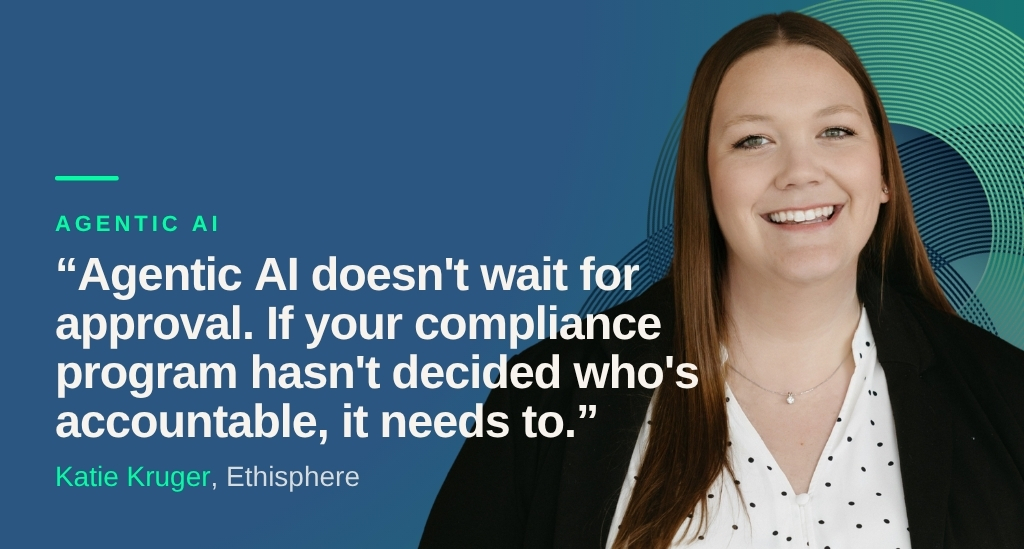
It’s as simple as an office that never runs out of printer paper. No one submits a request, gets an approval, or picks a vendor; an agentic AI system simply notices the office is running low, checks the budget, and places the order on its own, quietly and correctly, without a human in the loop. It sounds like something you’d once read about in sci-fi novels. Maybe in your organization it hasn’t happened yet, but it doesn’t take much imagination to see how close we already are.
Reams of paper may be an inconsequential example, but imagination could scale it up. An AI agent in your accounts payable department is authorized to process vendor payments under a certain threshold. It follows its instructions, executes a transaction, and the recipient turns out to be on the OFAC sanctions list. No human approved that specific payment. The agent did exactly what it was built to do. Who is responsible? Does your program have an answer to that question today, or are you assuming you’ll figure it out if it ever comes up?
What Is Agentic AI?
Generative AI edits your emails and drafts your code. Agentic AI is different. It doesn’t wait to be asked. It reasons through a goal, decides on the steps to get there, and acts on its own, often without anyone checking in along the way. These agents are already responding to customer complaints and issuing refunds, scheduling interviews and screening candidates, and yes, restocking the supply closet.
The simplest way to think about agentic AI is as a new category of employee. This digital employee needs to be onboarded, just like a new hire. These agents need their own identities, permissions, and constraints, the same way a new hire needs a job description, system access, and a manager. Your organization almost certainly has an HR function. It’s unlikely you have an “AI Relations” function (yet).
Three Assumptions Your Compliance Program Is Quietly Making
Compliance functions were built around humans and assumptions we can make based on human behavior. Agentic AI is entering the workforce and breaking the assumptions we’ve always made about accountable actors, the Code of Conduct, and monitoring.
Assumption One: Humans Are the Accountable Actors
When there’s an error or misconduct, we identify the decision-maker and hold them accountable. That’s the human default; the agentic default doesn’t exist. Increasingly, what a human tells an agent to do and what that agent does with it is another matter. Regulators and courts are starting to agree that accountability still runs back to a human somewhere. They’re a lot less sure which human. If you signed off on the deployment, that human might be you.
We talk a lot at Ethisphere about organizational justice. It’s one of the Eight Pillars of Ethical Culture we look at when we measure E&C culture. It’s, again, a very human-based deal: if you do the right thing and someone else doesn’t, the program catches them and appropriate action is taken. Agentic AI drops a grey area right into the middle of that deal. When an agent causes harm and nobody owns it, that grey area doesn’t stay theoretical. It lands on employees, and employees will want to know: could I receive a consequence for something an agent did? The deal already has fault lines. Ethisphere’s Culture Quotient data shows that 75.7% of employees who’ve taken our culture survey in the last two years believe the rules and disciplinary action for misconduct apply the same way to everyone; the other 24.3% aren’t so sure, or don’t agree at all. If AI causes organizations to start holding one category of “employee” to different rules, or none at all, it isn’t hard to guess which way that number moves.
Assumption Two: Your Code of Conduct Covers the Behavior in Question
Codes of Conduct, policies, and training programs are written with a human in mind. They assume the document is read, the values are internalized, and judgement is applied based on that knowledge when met with an ethical dilemma. Agentic AI doesn’t attend your ethics training, doesn’t sign attestations, and won’t call the hotline.
This is where AI governance steps in. These digital employees need the same, if not more, guidance and guardrails as the human employees governed by your E&C documents. But no code, however well-written, can spell out every judgment call an autonomous agent will face in advance. If a behavior isn’t named, it isn’t covered, and agentic AI will find those gaps faster than any of us can close them.
Assumption Three: Monitoring Catches What Needs to Be Caught
Traditional AI governance largely centers around a human-in-the-loop model. In Ethisphere’s recent survey of how E&C leaders are using AI, 60% of respondents reported that human review is an expected AI governance control before AI-generated work is used. Agentic AI is beginning to challenge that practice by shifting humans from reviewing every output to overseeing increasingly autonomous systems.
The dilemma here is that decisions that once took days now take seconds. Escalation procedures built for human timelines simply can’t keep pace with the deluge of decisions an AI agent can make. When something does go wrong, what record does it leave behind? Investigators can interview a human and reconstruct their reasoning. What does that reconstruction look like when the actor was software? Without immutable logs, timestamps, and clear authorization context, you may have no way to prove what an agent was actually authorized to do, let alone why it did what it did.
What a Compliance-Ready Deployment Looks Like
Agentic AI, our newest digital employee, is new to the workforce. The principles we’ve built over the years for governing people still apply to governing it.
Practically, it starts with the same steps you’d apply to a new hire. Define the agent’s identity, its permissions, and the boundaries of what it can do without escalation before it goes live. You wouldn’t wait until an employee made a misstep before training them; this governance should be decided before an incident forces its development. Base the boundaries on risk, impact, and reversibility. For example, a customer service agent answering FAQs needs less oversight than one issuing refunds; an agent evaluating candidates needs more oversight than one restocking supplies. The distinction is the backbone of an AI governance framework.
Human review of AI-generated work is the norm in most organizations today, but that won’t hold as agentic AI scales. The more durable model is risk-tiered review: intensive oversight for high-stakes, hard-to-reverse actions, lighter touch for low-risk, easily reversible ones. Build the audit trail into the system itself, not around it. Keep a record of what the agent did, what data it accessed to do it, and who authorized the boundaries it operated within. That’s the same infrastructure that allows compliance and investigations teams use AI to move faster without losing the human judgement at the center of the process.
Developing governance at the speed of AI doesn’t happen naturally; it has to be creatively, and intentionally, designed.
Five Questions for Your Next Cross-Functional Meeting
You don’t need to solve this alone, and you shouldn’t try to. Bring these five questions to your CTO and CISO:
- When an agent takes an action no human specifically approved, who is accountable — and have we decided that before deployment, not after an incident?
- Does our Code of Conduct and our AI policies actually name the behavior we expect from agentic systems, or are we assuming human-focused language already covers it?
- What record does each of our deployed agents leave behind, and could we reconstruct its reasoning the way we’d interview a human employee during an investigation?
- Where have we drawn the line between an agent acting freely and one that requires human escalation — and is that line based on risk, impact, and reversibility?
- If an agent’s action creates a consequence for an employee — a hiring decision, a disciplinary flag, a denied request — do our people understand who’s accountable, or are we quietly asking them to trust a black box?
Ultimately, agentic AI isn’t something out of a sci-fi book any longer. It’s a current operational reality with a governance gap hiding in plain sight. The organizations that treat this as a responsible AI question now, rather than an incident response question later, are the ones that have a shot at keeping employees’ trust when the first agent-caused incident makes headlines. The only question left is whether your compliance architecture was built for the employees you have today, or only for the ones you had yesterday.
Author Bio

Katie Kruger | Data Analyst, Ethisphere
Katie Kruger is a Senior Culture Analyst at Ethisphere, where she transforms employee feedback into clear, actionable insights that help organizations strengthen their ethical culture. She works closely with ethics and compliance leaders to understand how employees experience speaking up in the workplace and uses data-driven analysis to identify opportunities to create environments where raising concerns is safe, expected, and effective.