7 Minutes - Read Now
Most organizations collect more employee feedback today than ever before. But, they don’t exactly know what to do with all of that information the survey closes. The overall score gets reported up the chain, and the harder questions go unasked: What are employees experiencing? Where is risk building? What would move the needle?
When read correctly, a culture survey is a leading indicator of ethics risk. It shows where an organization’s culture is strong, where it’s vulnerable, and where the conditions that lead to misconduct are starting to take hold.
The real value in survey data is the pattern underneath the top-line number. That is, differences across employee groups and business units, and what employees say in their own words when given the chance.
Understanding Why the Data Looks the Way It Does
Quantitative data tells you what’s happening. Qualitative data tells you why it’s happening.
When organizations focus only on the scores and skip the open-text responses, they miss the experiences and behaviors driving those results. Survey questions measure specific aspects of culture, but employees are still answering inside whatever boundaries the survey gives them.
Open-text comments let employees explain what’s shaping their perceptions, flag problems leaders might not otherwise see, and describe the experiences that color how they view the culture.
Employees might score their leaders well on ethical commitment, but the comments tell a messier story: leaders who say the right things but don’t follow through when someone raises a concern, or whose standards shift depending on the team or the manager.
A well-designed culture survey provides much more information than a single overall score. By examining individual questions, demographic groups, organizational segments, and qualitative feedback, leaders can uncover insights that would otherwise stay hidden.
Culture scores improving year over year matters less than understanding what employees are experiencing, where those experiences differ, and what the differences might reveal about ethics risk.
The Gap Between Knowledge and Action
One of the most useful things survey data can reveal is the gap between what employees know they should do and whether they feel ready to do it. Understanding organizational policies and reporting channels matters, but knowledge alone doesn’t build an ethical culture. Employees also need to feel confident enough to act when they run into a concern.
Reporting rates are one measure of speak-up culture, but organizations still need to understand what drives whether employees act when they see misconduct. Ethisphere’s ethical culture data, collected from January 2024 through December 2025 across more than 1 million survey responses, found that only 52.4% of respondents who observed misconduct reported it.
Segmentation can show whether certain groups, teams, or locations trust an organization’s ethics systems less than others. Employee comments add the why: leadership behavior, past experience, confusion about the reporting process, or fear of what happens next.
Fear of Retaliation as a Measure of Cultural Health
Fear of retaliation remains one of the biggest reasons employees don’t report misconduct. Asking someone to risk their reputation, relationships, or career to raise a concern is a big ask. Organizations can’t assume every employee feels equally comfortable taking that step.
Of the employees in Ethisphere’s ethical culture data who saw misconduct and didn’t report it, nearly half cited fear of retaliation as the reason.
The data also shows real differences by region. Fear of retaliation is a global concern, but it’s not felt equally everywhere. Employees in the U.S. and Canada were more likely to cite it as a reason for staying silent than employees in other regions. Reporting metrics that look consistent at the top level can hide very different experiences of speak-up culture underneath.
Understanding why requires looking past the numbers. Qualitative feedback can show whether the hesitation is tied to leadership behavior, past experience, cultural norms, or how employees think concerns get handled.
The real question isn’t whether employees are willing to report, but whether they trust the organization to respond when they do.
Manager-Level Variation as an Indicator of Local Risk
Overall culture scores can create a false sense of consistency across an organization. Employees experience culture most directly through their immediate managers, and those experiences can vary widely across teams, departments, and locations.
A strong organization-wide score can mask pockets of risk where employees see leadership, accountability, or the organization’s commitment to its values very differently. Segmenting the results, and comparing them against peer benchmarks, can show where those differences exist. But the numbers alone won’t explain what’s driving them.
This is where qualitative feedback earns its keep. Employee comments can show whether the differences between teams trace back to manager behavior, communication habits, unclear expectations, or the specific pressures of a given role.
A customer-facing employee juggling demands from customers and managers faces different ethical pressures than an engineer who rarely deals with customers at all.
Managers are where organizational values turn into day-to-day experience. Knowing where that experience differs, and why, lets leaders target support where it will make the most difference.
Look for Patterns, Not Isolated Scores
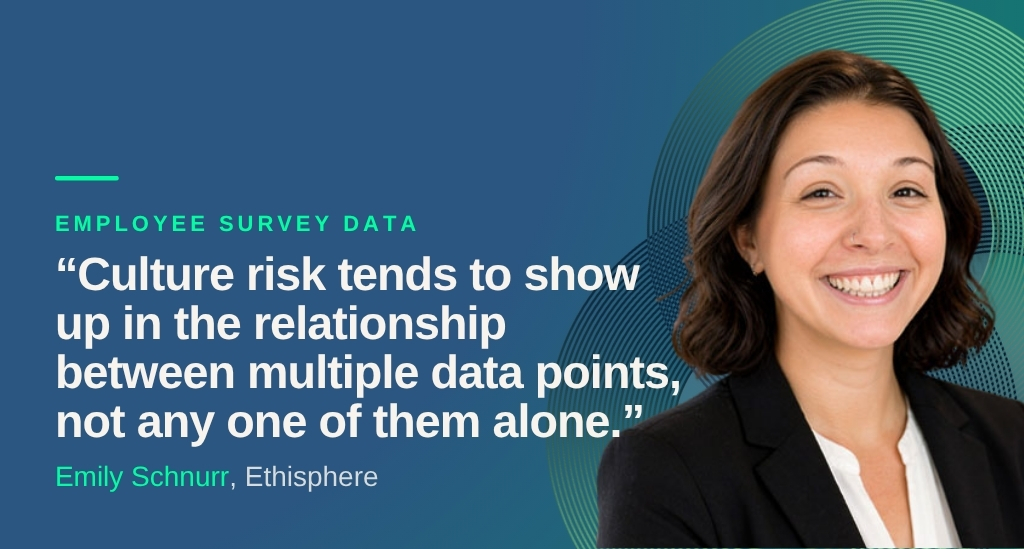
The most useful insights rarely come from a single survey question. Culture risk tends to show up in the relationship between multiple data points, not any one of them alone.
High awareness of the Code of Conduct looks like good news on its own. But if those same employees report low confidence that concerns will be taken seriously, the picture changes. They understand what’s expected of them, but they don’t trust the systems built to back them up.
Qualitative feedback can reveal the factors driving that disconnect, such as inconsistent responses to concerns or past experiences that have shaped employees’ willingness to speak up.
High overall satisfaction scores don’t guarantee a strong ethics culture if those same employees say they’ve never seen real action taken when concerns are raised.
The Hardest Findings Are Often the Most Valuable
One of the most useful things survey data can do is point leaders to where they need to look more closely. When a finding is uncomfortable, the instinct is often to explain it away or retreat to the overall numbers. But the uncomfortable findings are usually the ones worth acting on.
Say a survey turns up one business unit where employees report unusually high pressure to compromise the Code of Conduct to hit business goals. That’s a real signal.
Rather than treating that as proof the business unit has a “bad” culture, leaders can dig into what’s driving the perception. The quantitative result flags the concern; the open-text responses point to why: unrealistic targets, conflicting priorities, incentive structures, or leadership behavior.
That’s the real use of an uncomfortable finding: understanding what’s driving the behavior and fixing it before it becomes a bigger problem.
Moving From Measurement to Action
A mature ethics culture measurement program doesn’t treat survey results like an annual report card. It treats employee feedback as an ongoing signal, one that shows where culture is strong, where risk is building, and where targeted action will do the most good.
The organizations that get the most from culture data care less about the score than about what drives it, and they use that understanding to make decisions, often after comparing notes with peers working through the same questions.
A rigorous approach to ethics culture measurement moves the question from “How did we perform this year?” to “What is our workforce telling us, and what should we do about it?”
The organizations that make real progress don’t stop at measuring culture, they use what the data tells them to shape it. That data already exists in most organizations. The only thing missing is the will to listen to it.
Author Bio

Emily Schnurr | Culture Analyst, Ethisphere, Guest Contributor
Emily Schnurr is a Culture Analyst on Ethisphere’s Data & Services team, contributing to culture assessment projects that help organizations measure and improve their ethical culture. She supports client engagements by analyzing survey data and translating findings into actionable insights.