BELA South Asia Webcast Series: EY’s Global Integrity Report 2020 – Spotlight on India

BELA South Asia Webcast Series: EY’s Global Integrity Report 2020 – Spotlight on India

The EY 2020 Global Integrity Report comes at a time of unprecedented instability. Globally, a diverse set of stakeholders are examining integrity through a very different lens. Surveying more than 3,500 employees and business leaders across 33 countries in the lead-up to and height of COVID-19 from within some of the most influential companies in the world, this was a unique moment to catalogue and measure the shifts in business behavior, ethics, and management.

Related Resources

8 Ways to Elevate Ethical Culture: Enabling Managers and Supervisors

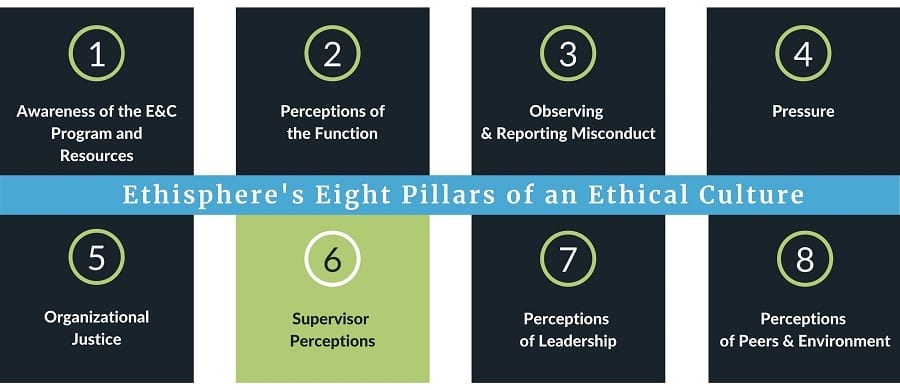
In this series, we share insights into the eight pillars that make up a robust ethical culture. Our eight pillars seek to get at the key metrics of a strong ethical culture: Do your employees understand what is expected of them? Do they know where to go if they have questions? And, if they need help or have made a mistake, do they trust the process enough to go through with it?

In our previous posts, we’ve discussed:

Today’s post focuses on perceptions of managers and supervisors.

PILLAR SIX:

Supervisor Perceptions

What we aim to measure:

Employee perceptions of their immediate supervisor, and whether that leader is an ethical role model and fosters an environment which encourages questions about and reporting of ethical misconduct.

Types of questions we ask:

  • I believe my manager is committed to ethical business conduct at all times.
  • I am comfortable approaching my manager with issues or questions related to ethical conduct.
  • My manager is consistently a role model for ethical behavior and demonstrates the importance of integrity and ethical behavior.
  • My manager discusses ethics or compliance related issues/topics.

Why it matters:

Based our experience and data, managers throughout the organization are the single most influential factor in establishing and maintaining a healthy ethical culture. Managers, by default of their elevated roles, become the most accessible models for how to succeed and advance your career path within an organization. Ensuring managers are modeling the type of decision-making and leadership behaviors that align with the organization’s ethical standards and directives is of paramount importance.

Managers are also the most likely channel to be used by employees when raising a concern about suspected misconduct.

It becomes a significant hurdle for the organization if there are areas within the business where employees become uncomfortable approaching their direct manager – or even their manager’s manager – with concerns.

What the data says:

This pillar tends to be an area that strongly correlates with all other areas of culture measurement:

89 percent of surveyed participants believe their manager is committed to ethical business conduct at all times

88 percent of survey participants expressed they are comfortable approaching their manager with issues or questions related to ethical conduct

76 percent of participants indicated their manager discusses ethics or compliance related issues/topics at least one per quarter on average.

Organizations within the dataset are committed to a strong ethical culture and are leaders at equipping managers to lead ethically and create an open-door environment. However, opportunities still exist to leverage managers as tone-setters for ethical culture throughout an organization.

Nearly a quarter of employees are only being reached by their managers with ethics and compliance related discussions just once per year – or not at all.

It is important to note that within our dataset, employees are more than twice as likely to be comfortable approaching their manager if there are at least quarterly discussions of ethics or compliance related issues/topics by managers.

Managers are the tide that raises all ships with respect to employee perceptions of ethical culture, so increasing the frequency of these communications should remain top of mind for all ethics and compliance functions.

How Ethisphere clients have used the data/insights:

Ethics and compliance leaders often use the data from this pillar to set the tone for manager training, helping managers understand why it is so important that they hear employee concerns, listen with an attitude of appreciation (even if it’s bad news), and know where to go for help addressing an issue or answering an employee question.

It’s also important to note that fostering a “speak up” culture provides benefits beyond ethics and compliance.

When employees feel comfortable raising ethical concerns, they will be more likely to share new product ideas, client challenges, and so much more. Preparing managers to lead teams where everyone is comfortable using their voice is time well spent.

Expert tips for your program effectiveness:

  • Provide managers with a variety of resources that facilitate organic discussions about ethics and compliance related topics or issues. Develop the communication assets with appropriate context that anchors the messaging in the “lived” employee experience.
  • Establish appropriate metrics – and rewards – for managers to assess performance and adherence to ethical standards.
  • Facilitate peer-to-peer knowledge transfer between managers to disseminate practical behaviors and efforts that amplify messaging from the central ethics and compliance function. Champion managers that are doing this at a high level.

As ethics and compliance leaders continue to put significant effort into their program, the question for many remains “is it working?” We hope these insights into our Ethical Culture assessment and data set are helpful in answering that question for you. If you are interested in taking a more detailed look at our data set of 1.1 million employee responses, contact us today to talk to our team about your ethical culture.

Have questions about ethical culture? Schedule time to talk with an Ethisphere expert, or subscribe to our “Culture Corner” newsletter to stay up-to-date on ever-changing culture trends and data.

Subscribe to “Culture Corner” >
8 Ways to Elevate Ethical Culture: Ensuring Organizational Justice

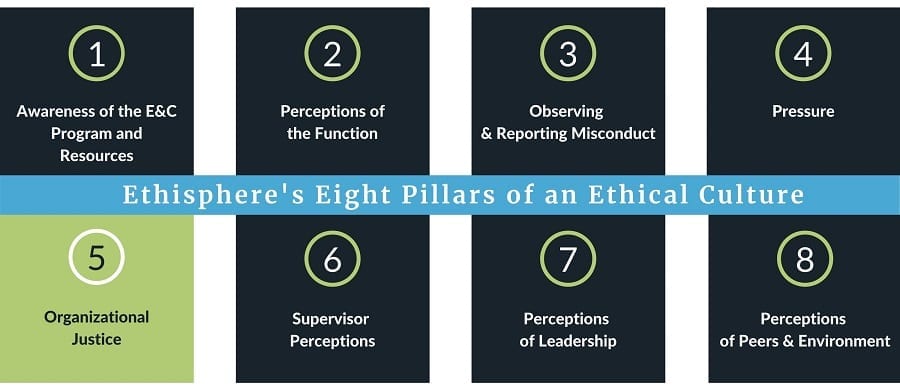
In this series, we share insights into the eight pillars that make up a robust ethical culture. Our eight pillars seek to get at the key metrics of a strong ethical culture: Do your employees understand what is expected of them? Do they know where to go if they have questions? And, if they need help or have made a mistake, do they trust the process enough to go through with it?

In our previous posts, we’ve discussed:

Today’s post focuses on perceptions of organizational justice.

PILLAR FIVE:

Organizational Justice

What we aim to measure:

Colloquially referred to within Ethisphere as the “Animal Farm” pillar, this group of questions focuses on employee perceptions of whether the company holds every wrongdoer accountable, regardless of rank. It also considers the awareness of discipline and the investigation process.

In other words, are all the animals equal? Or are some of them more equal than others?

Types of questions we ask:

  • I believe disciplinary actions are taken when individuals engage in unethical behavior or misconduct at the Company.
  • I believe the rules and associated disciplinary actions for unethical behavior or misconduct are the same for every employee.
  • If I raised a concern about unethical behavior or misconduct, I believe the Company will fully investigate it.

Why it matters:

The act of stepping forward to raise a concern is courageous. Employees want to know this act will be respected by the organization and action will be taken to properly address the concern. Perceptions of organizational justice hinge on employees believing the rules apply equitably to everyone and that no individual – regardless of stature within the organization – is above the consequences of misconduct. When an organization fails to create this sense of equality, it introduces a corrosive force that runs against efforts to establish and maintain a “speak-up” culture.

Our data shows employees who agree disciplinary actions are handled equitably are 74 percent more likely to have reported observed misconduct than participants who were unwilling to affirm such faith in equitable disciplinary measures.

When employees do not believe the organization will take the matter seriously, either through investigation or adjudication, they are forced to make a decision as to whether doing the right thing will justify the vulnerability that comes with stepping forward.

What the data says:

This pillar tends to be an area that reveals critical opportunities within organizational pockets, often determined by the strength of proactive efforts to educate the employee population about the reporting, investigations, and adjudication processes:

81 percent of surveyed participants expressed faith their company will fully investigate a reported concern about unethical behavior or misconduct.

Yet just 72 percent of participants indicate they believe disciplinary actions are taken when individuals engage in unethical behavior or misconduct at their company.

31 percent of participants did not affirm they believe the rules and associated disciplinary actions for unethical behavior are the same for every employee at their organization.

The reality is that the majority of employees are unlikely to find themselves in a position to report misconduct, participate in an investigation or be privy to the adjudication process while employed by an organization. That does not excuse an organization from making the effort to educate employees about these processes, because in that void a narrative of hearsay will become the default reality.

If it takes one instance for an organization’s reputation to experience critical damage, is it worth leaving such a determining factor about whether employees raise a concern up to hearsay?

How Ethisphere clients have used the data/insights:

The delta between the number of employees who say their organization would investigate a concern and those who are confident action would be taken varies by company but exists for every client we have worked with. The size of the delta reveals the degree to which the company needs to work to “lighten” the black box of investigations for employees to make what happens less of a mystery.

Expert tips for your program effectiveness:

  • Proactively outline what to expect after reporting a concern through the various modalities available to employees.
  • Make the investigator code of conduct readily available to all employee.
  • Educate the employee population about the full spectrum of disciplinary actions the organization may take, not just termination, so that an employee isn’t surprised when a colleague receives coaching in response to misconduct.
  • Create a simple process that allows managers to easily log any open-door report that has been brought to their attention.

As ethics and compliance leaders continue to put tremendous effort into their program, the question for many remains “is it working?” We hope these insights into our Ethical Culture assessment and data set are helpful in answering that question for you. If you are interested in taking a more detailed look at our data set of 1.1 million employee responses, contact us today to talk to our team about your ethical culture.

Have questions about ethical culture? Schedule time to talk with an Ethisphere expert, or subscribe to our “Culture Corner” newsletter to stay up-to-date on ever-changing culture trends and data.

Subscribe to “Culture Corner” >
The Case for Greater Disability Inclusion at the Company: Values, Metrics, and Long-Term Performance

The Case for Greater Disability Inclusion at the Company: Values, Metrics, and Long-Term Performance

Session Spotlight:

If your company hasn’t considered the strategic advantages of disability inclusion, this session is one to catch. It lives up to the “inspiring and actionable conversation” description from moderator John Pluhowski, SVP & Chief Communications Officer, Corporate and Public Affairs, TD Bank.

In the discussion, we hear from Ted Kennedy Jr., Board Chair, American Association of People with Disabilities (AAPD); Paul J. Gennaro, Senior Vice President, Chief Brand and Communications Officer, Voya FinancialJenny Lay-FlurrieChief Accessibility Officer, Microsoft; and Camille Chang GilmoreVice President of Human Resources and Global Chief Diversity Officer, Boston Scientific Corporation.


The 2021 Global Ethics Summit was Ethisphere’s flagship event and the premier place for companies and delegates to learn, develop, and share ideas that elevate the field of business ethics and compliance. This year’s Summit showcased more companies and featured additional points of view while bringing together a larger community of leaders. This Summit also provided attendees, faculty, and sponsors with close to 40 different sessions, inclusive of plenary, breakout, and select company showcases.

This resource is part of the selected multimedia collection of on-demand resources that was made available to the public this year. If you are a Summit attendee, please reach out to Cassidy Davis at [email protected].

Turning Uncomfortable Conversations Into Inclusive Behaviors – Real Biz Shorts (RBS)

Turning Uncomfortable Conversations Into Inclusive Behaviors

Innovative ways to help your employees gain greater awareness of social issues, build empathy, and behave more inclusively.

Related Resources