6 Minutes - Read Now

You’re already aware of what challenges your industry faces, and perhaps even how your peers in similar roles are handling them. Benchmarking against your own sector is part of the job, and most ethics and compliance leaders do it well.
But what about the chief compliance officer at a company in another sector? What does she know about board dynamics that you don’t? What’s the compliance leader at a global manufacturer seeing that might apply to your organization?
Ethisphere built the 18th Global Ethics Summit around those questions. From March 30 to April 1, 2027, at the Omni Atlanta Hotel at Centennial Park, ethics and compliance leaders from different industries, company sizes, and parts of the world will spend three days in the same rooms, and the program mixes them on purpose.
The Blind Spot You Can’t See From Inside Your Own Company
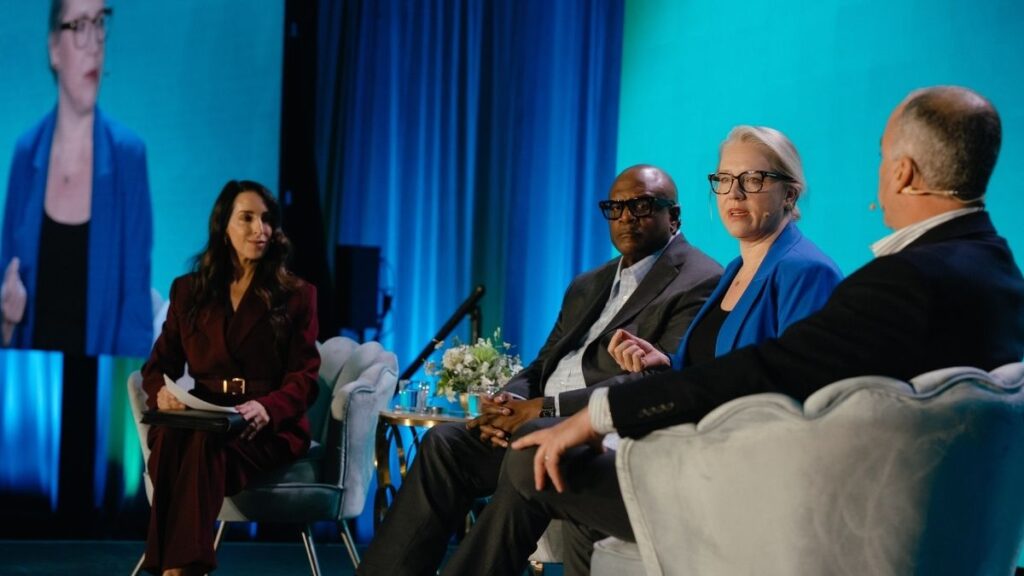
Nathan Prater knows a crisis plan can be technically sound and still wrong. At the 2026 Summit, Prater, VP Group Compliance & Ethics at Ahold Delhaize, told the room about the international food retail group’s first crisis playbook. It defaulted to command-and-control inside an organization that runs on consensus, and pas a result, people felt left out. So the company rebuilt the plan around its stated values.
Prater shared the stage with leaders from Intel and Meta, a chipmaker and a social media company with little in common with a grocery group. But that gap made Prater’s story more useful because it was industry-agnostic. Every crisis plan assumes something about how decisions get made. You rarely notice your own assumption until someone from a different kind of company describes theirs. A compliance leader at a bank or a hospital system could leave that session with a question about their own playbook they had never thought to ask.
How the Program Moves You Across Sectors
On the morning of March 30, attendees will split into six industry roundtables: Energy & Utilities, Financial Services & Insurance, Healthcare, Manufacturing, Retail/Consumer Goods, and Software & Technology. You start with the people who answer to the same regulators and speak the same shorthand.
Breakout sessions take on problems that cut across every sector: third-party monitoring, the investigations process, AI governance that holds up after the framework is written, champions networks, and due diligence disclosures under the EU’s Corporate Sustainability Due Diligence Directive (CSDDD). If you’re wrestling with one of them, you’re in the room with everyone else who is, whatever their industry. Expert-led, closed-door Peer-to-Peer Conversations give you another place to compare notes, and in Programs in Action sessions, Business Ethics Leadership Alliance (BELA) member organizations walk through recent work in programs that may look nothing like yours.
On April 1, the Peer Exchange Luncheon sends everyone back to their industry roundtables. You sit down with your own sector again, this time carrying ideas from everyone else.
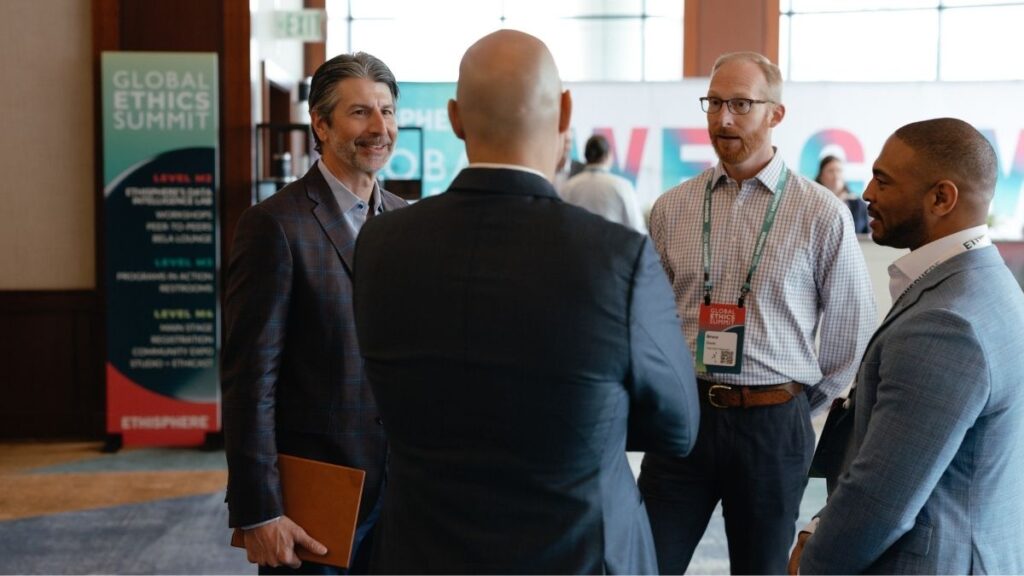
Chelsie Dumenigo, Ethisphere’s Vice President of Marketing, sees it happen all the time. Someone in a breakout raises a problem they’ve circled for three months, and two people at the table have already worked through it. The 600-seat cap on in-person attendance keeps the event “small enough for real conversations between sessions, and big enough that you’ll meet peers from industries and regions you usually don’t hear from,” she wrote this fall.
Your Peer Network Shouldn’t Stop at the Border
A compliance program run from Europe or Asia answers to different enforcement regimes and different expectations about speaking up. If you’re a U.S.-based leader with operations abroad, you need to understand those programs, and the fastest way is to talk with the people running them.
On April 1, the main-stage session “Spanning Both Sides of the Atlantic” looks at what’s changing in corporate enforcement in the U.K. and the U.S. The CSDDD breakout covers European due diligence rules that also reach large companies based outside the EU.
Those sessions show how the rules differ across borders. The conversations around them show how programs in other countries respond, and those responses are what attendees take home. The ethics and compliance leadership team at SeAH Holdings said the Summit “provides the ability to network with companies with excellent programs around the world and set new directions and goals for our improvement in the future.”
Big Programs and Lean Programs Have a Lot to Teach Each Other
Leaders of large programs rarely hear how a small team covers the same ground with a fraction of the headcount. Meanwhile, leaders of lean programs rarely get to ask a global enterprise how it scaled the thing they’re building right now.
At the Summit, they both sit at the same tables. A peer from a larger organization can tell you which parts of their speak-up program broke as it grew, which could save you a year. A leader from a smaller program can show a global team how to get a training message across without a production budget. You won’t have either conversation if everyone in your network runs a program like yours.
Pete Blumberg, VP and Chief Compliance Officer at FedEx, has described why that matters: “Everyone in this field benefits from everyone else’s innovation … and I think it is one of the most important things that either compliance leaders do, or people who aspire to be compliance leaders, is learning all the time.”
Make the Most of the Mix
At the Summit, you’ll meet people you wouldn’t have found on LinkedIn, and you’ll hear perspectives that don’t come from your usual circles. A few ways to make the most of them:
- Pick at least one breakout on a risk your industry hasn’t felt yet
- Sit with strangers at meals and receptions instead of the colleagues you came with
- Choose a Programs in Action session from an organization outside your sector
- Bring one idea from another sector back to your industry roundtable on the final day
The 2027 theme, Human-Centered, AI-Assisted, poses questions no single industry has solved: what to automate, what to govern, and what stays human. Leaders will work out those answers faster by comparing notes across sectors than by waiting for their own industry to settle them.
The Medium Early Bird rate of $2,795 for in-person attendance and $1,295 for virtual runs through Dec. 16, 2026. BELA member organizations have complimentary passes, plus a member rate on additional seats.
Come ready to learn from people who aren’t like you. See the full agenda and breakout topics, and register for the 2027 Global Ethics Summit, at attendges.com.
Author Bio
Bill Coffin | Editor-in-Chief, Ethisphere Magazine, Ethisphere
Bill Coffin is an internationally recognized writer and editorial leader in the fields of ethics, compliance, insurance and risk management. His work has appeared in The Wall Street Journal, BusinessWeek, Forbes and Fortune, as well as Compliance Week, National Underwriter, Risk Management, Best’s Review and other B2B media. Previously, Bill served as Director, Senior Editor at AIG, leading content strategy for one of the world’s largest insurance companies.