Global Ethics Summit Highlights: ESG with Extra “S”
AUTHOR: Emily Rickaby Director, Shared Expertise and Strategic Projects
Environmental, Social, and Corporate Governance (ESG) was one of the most popular topics at the Global Ethics Summit this year, and for good reason. ESG is in the spotlight for investors, shareholders, employees, customers, and other stakeholders – and, increasingly, on the agendas of ethics and compliance leaders. In 2020, the ‘S’ in ESG moved to the forefront, with companies expanding actions related to social justice, inclusion, and human rights.
The Ongoing Challenge of Effective ESG Reporting and Data Disclosure
EY’s Marc Siegel shared an overview of the differing approaches: standard setters (GRI, SASB), frameworks put out by international organizations (e.g., UN Sustainability Development Goals, International Integrated Reporting Council), data aggregators, and rating agencies offering a ‘quick’ score/ranking. He drilled down on each of the frameworks to offer insights into determining the best approach, and explained the different types of assurance and ways to involve finance and others.
“Understanding which of these issues are most important towards progressing your businesses goals is extremely important and will help the entirety of the organization, not just ESG reporting.“
– Marc Siegel, Partner, Financial Accounting Advisory Services, EY, SASB Board Member and former FASB Board Member, EY
Marsh & McLennan’s Kate Brennan shared insights into how the company’s reporting evolved to an integrated ESG report that factors in all leading guidance and focuses on data most relevant to their work. It also covers the governance structure and committee responsibilities. She emphasized the importance of working across an organization and the role of compliance.
“The Compliance function has a strong role to play in talking about and identifying how ESG fits into the culture and the purpose of the company. Compliance officers, as culture ambassadors, need to take the opportunity to learn about these issues and become advocates for change on these issues before these disclosures become mandatory,” she notes.
Schnitzer Steel Industries’ Brian Lewallen shared the company’s three-factor analysis in deciding disclosures, looking at: purpose, audience, and scope. He discussed how they will use some metrics to gauge continual improvement. He also explained how ESG disclosure expectations are growing and how to balance transparency with the ripple effects of new disclosures, such as risks that could be required in SEC reporting.
He notes, “Being reactive in a disclosure setting is a very dangerous position to be in. To the extent you are not already disclosing voluntarily now, I would encourage you to start…try to be proactive. There are a lot of time and resources invested in ESG disclosures–use the feedback and the scores you get, and gaps presented back to you to drive change in your organization, to become more sustainable and a better company for it.”
The S in ESG: Prioritizing and Measuring Actions on Human Rights Issue
The definition of human rights continues to evolve and expand for companies. Many that have focused on fair labor and anti-slavery are now also looking at equal opportunity, inclusion and access to the fundamentals and freedoms of life. International human rights principles inform programs, the focus is specific to their companies and industries – in the case of Western Union, addressing risks most common for FinTech companies, and for J.M. Smucker looking closely at the supply chain, from safe work environments to employment practices and opportunities.
Mandated requirements and the rise in enforcement around human trafficking provide the entry point for companies looking to address broader human rights issues.
Cynthia Cordes, Partner, Husch Blackwell and nationally recognized former federal prosecutor, shares her experience: “The companies with the most robust compliance programs are always the ones who are less likely to end up in litigation and under investigation. Those who are wanting to take a more minimalist approach, don’t want to be proactive, kind of want to skim where it comes to cost on compliance, those are ultimately the ones who have bigger issues that arise but actually spend more on legal costs and remedy efforts because they have to be reactive and defend. Compliance programs not only speak to the integrity of a company but are important to invest in for risk mitigation and cost mitigation down the road.”
Equity and Social Justice: Is It Different This Time?
EQUITY & SOCIAL JUSTICE:
The Necessary Influence of the Business Community to Address What Divides
All agreed that the events of 2020 sparked a new resolve among many companies, and increased awareness and calls for change among a broader range of stakeholders.
In the words of Steve Rendle, “This is a time where actions need to speak much more loudly than words. Our stakeholders are looking very directly at what we will do to drive change and to create a culture of belonging, not just inside our four walls, but how we impact those communities that we live and work in and really empower our associates, our employees to take a proactive role in reaching into their communities and helping to drive change. It’s so, so important today, more important than ever.”
David Huntley added, “At AT&T, there are all kinds of initiatives that we have taken to not just give money to certain groups, but to really hold the mirror up to ourselves. It starts with us a company and what we are doing for employees and taking that lens and extending it to what we are doing in our respective communities.”
“It starts with us a company and what we are doing for employees and taking that lens and extending it to what we are doing in our respective communities.“
David Huntley, SEVP & Chief Compliance Officer AT&T Inc.
The death of George Floyd was tragic and transformational. In companies, leaders were being asked to speak out and step forward to drive change, and many recognized that they had to talk openly with their employees.
At AARP, Jenkins immediately moved into action. She hosted an all-staff ‘Courageous Conversations’ call and invited employees to share videos of personal stories. There was an overwhelming response.
Jenkins also shared a personal story about being an African American woman raising two African American children. “I got more responses and comments from the staff than on anything I have said to them in the six years that I have been CEO. That was the first time that for many of my Caucasian colleagues that it was real for them, that even Jo Ann was having that kind of experience.” AARP continues to invite staff from across the to continue those conversations. They also share stories with the Board.
Likewise, VF Corporation put together listening sessions across the organization. The conversations were candid, and in some situations, extremely uncomfortable for those who haven’t experienced the same bias. Yet, they were vital to moving forward.
Businesses stepped up. Moving forward, the greatest challenge is keeping it going. AARP has put systems in place–elevating the Chief Diversity Officer to the executive team; putting leaders and the Board through unconscious bias training; and building out a diversity, equity, and inclusion framework around workplace, workforce, and marketplace.
Yet Jenkins highlights that “this is not a problem that is going away” and needs to remain front and center.
For VF Corporation, “The actions that we are taking and commitments we are making need to be embedded in our corporate and brand strategies. If in fact we are driving against those strategies that that we have put forward, that enable us to deliver our commitments to our stakeholders and shareholders. Those are the guardrails. These are the things we have stated are important to our consumers, that will drive the level of performance that we expect of ourselves,” stated Rendle.
THE CASE FOR GREATER DISABILITY INCLUSION AT THE COMPANY:
Values, Metrics, and Long-Term Performance
1 billion
disabled people in the world
1 in 4
people have a disability
1+ million
service-connected veterans with a 70% – 100% disability
33 PERCENT
labor force participation rate for people with disabilities; 76% without
Jenny Lay-Flurrie shares that the investment in disability inclusion is worth it. “We see this every day at Microsoft, by having talent with disabilities giving their expertise and insight into our products, our products are quite simply inclusive and better.”
Voya Financial is recognized by Ethisphere as a World’s Most Ethical Company–which factors in diversity and inclusion into the honor. The company has also been awarded a “Best Place to Work for Disability Inclusion.” According to Paul Gennaro, “Consumers are looking to see on your advertising more representation of people with disabilities and special needs…On social media, we’ve leveraged disability inclusion from a content standpoint, and it has outperformed anything else we have done… There is an appetite out there, it’s just smart to do.”
Ted Kennedy highlighted the business imperative of disability inclusion, “People now are focusing more and more on the companies that they do business with…People with disabilities want to align with companies who share their vision and goal for equality and justice for the things they care about. It’s here to stay… Disability inclusion is the next chapter of ESG and corporate responsibility.”
“Disability inclusion is the next chapter of ESG and corporate responsibility.“
Ted Kennedy Jr., Board Chair, American Association of People with Disabilities
Global Ethics Summit Session: An Inclusify Mindset – Practical Changes Companies Can Make to Progress D&I. Presenters include Dr. Stefanie K. Johnson, Associate Professor and Author of INCLUSIFY, University of Colorado Boulder Leeds School of Business; Antonio Fernandez, Vice President, Chief Ethics and Compliance Officer, FirstEnergy, Terry H. Stringer, Head of Ethics Office Employment Ethics Compliance & Investigations, HP, Inc.; and Ash Mishra, Senior Assistant General Counsel, Polaris Industries
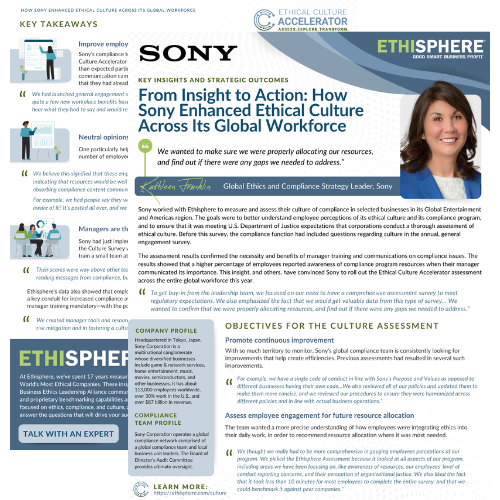
Insights and Outcomes from Benchmarking Ethical Culture
“We thought we really had to be more comprehensive in gauging employees perceptions of our program. We picked the Ethisphere Assessment because it looked at all aspects of our program, including areas we have been focusing on, like awareness of resources, our employees’ level of comfort reporting concerns, and their perception of organizational justice. We also liked the fact that it took less than 10 minutes for most employees to complete the entire survey, and that we could benchmark it against peer companies.” – Kathleen Franklin, Global Ethics and Compliance Strategy Leader, Sony Corporation
Headquartered in Tokyo, Japan, Sony Corporation is a multinational conglomerate whose diversified businesses include game & network services, home entertainment, music, movies, semiconductors, and other businesses. It has about 117,300 employees worldwide, 13% of whom work in the U.S., and over $78.7 billion in revenue.
In 2018, Sony implemented Ethisphere’s Ethical Culture Survey to selected businesses in its Global Entertainment and Americas region. The goals were to better understand employee perceptions of its ethical culture and its compliance program, and to ensure that it was meeting U.S. Department of Justice expectations that corporations conduct a thorough assessment of ethical culture. Before this survey, the compliance function had included questions regarding culture in the annual, general engagement survey.
Featuring: Kathleen Franklin, Global Ethics and Compliance Strategy Leader, Sony Corporation
“Our leaders model desired behaviors by setting the right tone at the top, reinforcing through daily interactions that ethics are important and taken seriously, talking about the importance of ethics and doing the right thing, and embedding ethical values into everyday actions so that employees gain a sense of ‘how we do things around here,’ which is then integrated into daily activities.” – Joan Kissel, Executive Vice President & Chief Ethics Officer, Old National Bank
Old National Bank, founded in 1834, is a service- and community-focused financial institution serving Indiana, Kentucky, Michigan, Minnesota, and Wisconsin. The company has been a World’s Most Ethical Companies honoree every year since 2012; and has also been recognized by the National Organization on Disability (NOD) as a 2019 Leading Disability Employer; has received a 2019 Military Friendly Top 10 Employer designation; and was named to the 2019 Bloomberg Gender-Equality Index (GEI).
At Old National Bank, the ethics and compliance programs are jointly let with nearly 40 full-time associates across the two areas. The ethics function is managed by the Chief Audit Executive & Ethics Officer who reports functionally to the Audit Committee of the Board and administratively to the CEO. Risk assessments related to program elements, such as tone from the top, culture, personnel, and fraud are managed by the audit department. The compliance function is managed by the Chief Risk Officer (CRO) who reports functionally to the Enterprise Risk Committee of the Board and administratively to the CEO. The CRO is responsible for enterprise risk management and bank-specific regulatory compliance.
Featuring: Joan Kissel, Executive Vice President & Chief Ethics Officer, Old National Bank
“A lot of the things we’ve developed have come from being part of Ethisphere’s community and getting these assessments, because that’s where we hear about the importance of training and get ideas about what other companies are doing. Ethisphere is our primary connection to best practices in the business community and the concentrated source of wisdom about how to keep raising our game.” – Mark Ohringer, Executive Vice President, Global General Counsel and Corporate Secretary, JLL
Even if you don’t know the name, it’s very possible you’ve been in one of JLL’s buildings, since they manage over four billion square feet of commercial and residential space in over 80 countries around the world. In each building, the owners trust JLL’s team to act ethically. For the last ten years, Ohringer has relied on Ethisphere’s Program Assessments as a key barometer for how JLL’s ethics and compliance program is helping further that mission.
Featuring: Mark Ohringer, Executive Vice President, Global General Counsel and Corporate Secretary, JLL